
Extra stock has a habit of taking over useful workspace.
It begins with a few cartons beside a desk. Then packaging materials fill the meeting room, archived files occupy valuable cabinets, and seasonal inventory starts blocking the back entrance. Before long, employees are working around boxes that should not be in the office at all.
That is when business storage Dubai services become practical. A company can move stock, documents, tools or spare furniture into a separate facility without immediately committing to a larger office or conventional warehouse.
The right arrangement depends on how the business operates. An online seller needs quick access to active stock. A consultancy may only need archive space. A contractor might store equipment between projects, while an established company may require temporary capacity during an office relocation.
There is no single unit that suits all four.
What Is Business Storage in Dubai?
Business storage is rented space used for commercial belongings rather than household items. Companies commonly use it for:
- Retail and e-commerce inventory
- Packaging materials
- Archived documents
- Office furniture
- Computers and spare equipment
- Exhibition stands
- Marketing materials
- Tools and contractor supplies
- Seasonal products
- Returned or replacement stock
Unlike a traditional commercial lease, storage can often be increased or reduced as requirements change. This makes business storage in Dubai useful for startups, SMEs and larger organisations dealing with temporary or uneven demand.
A retailer may need extra room before Ramadan or the end-of-year sales period. A renovation company might require space for tools between contracts. A business moving offices may only need storage for six weeks.
The service solves a space problem without forcing the company to redesign its entire operation.
When Does a Dubai Business Need Extra Storage?
A full office does not always mean a business needs a larger office. The problem may simply be that valuable working space is being used for the wrong purpose.
Storage is worth considering when:
- Stock is blocking desks, walkways or meeting areas
- A home-based business has outgrown a spare room
- Seasonal goods only sell during part of the year
- Business records are rarely used but must remain organised
- A new office is not ready when the previous lease ends
- Imported stock arrives before retail or fulfilment space is available
- Equipment is only required for specific projects
- A shop has limited back-room capacity
- The business needs temporary room during renovation
- Product returns and replacement units are becoming difficult to manage
An SME should compare the cost of external storage with the cost of using prime office or retail space for cartons. In areas such as Business Bay, JLT, Downtown Dubai and Sheikh Zayed Road, the back corner of an office is rarely the most sensible place to hold slow-moving inventory.
Types of Business Storage Solutions in Dubai
The term commercial storage covers several arrangements. Understanding the difference matters because pricing, access and handling can vary considerably.
Self Storage Units
A self-storage unit gives the business a defined, lockable space. It works well for boxed stock, equipment, promotional materials and office furniture.
The tenant usually controls how the unit is organised and may be able to visit during the facility’s published access hours. Before booking, confirm whether employees, couriers or suppliers can be authorised to enter.
Box Storage
Box storage in Dubai suits companies with documents, samples, spare parts or limited quantities of stock.
The business may pay according to the number of cartons rather than renting a complete room. This can be economical for archive files or low-volume inventory, although retrieving individual boxes may require advance notice.
Inventory Storage
Inventory storage is intended for products that are waiting to be sold, transferred or dispatched.
It suits e-commerce sellers, online retailers, wholesalers and businesses with seasonal demand. The unit should be arranged by product code, batch or category rather than by delivery date alone.
Fast-moving goods belong near the entrance. Reserve stock can sit further back.
Warehouse Storage
Businesses with pallets, bulky products or frequent commercial deliveries may require warehouse storage in Dubai rather than a small self-storage room.
Warehouse arrangements may offer more room for loading, stock handling and commercial goods. They are better suited to growing inventory volumes, shop fittings, tools and packaged products that cannot be managed comfortably inside a small unit.
Document Storage
Document storage is used for contracts, invoices, employee records, project files and other business paperwork.
Files should be placed in numbered archive cartons and recorded in a digital index. Labelling a box “Accounts 2024, supplier invoices, boxes 1 to 4” is far more useful than writing “old files.”
Documents containing confidential information also need controlled access and a clear retrieval process.
Climate-Controlled Storage
Electronics, paper records, leather samples, wooden furniture and some commercial products can be affected by prolonged heat or humidity.
Climate-controlled storage in Dubai provides a more stable environment than basic non-controlled space. It may cost more, but additional wrapping cannot fully compensate for unsuitable storage conditions.
Equipment and Furniture Storage
Companies often accumulate spare chairs, desks, shelving, monitors and equipment after reorganising an office.
These items can be stored until they are needed at another branch, sold or reused. Furniture should be cleaned, dismantled where practical and protected with moving blankets or breathable covers.
Business Storage Versus a Traditional Warehouse
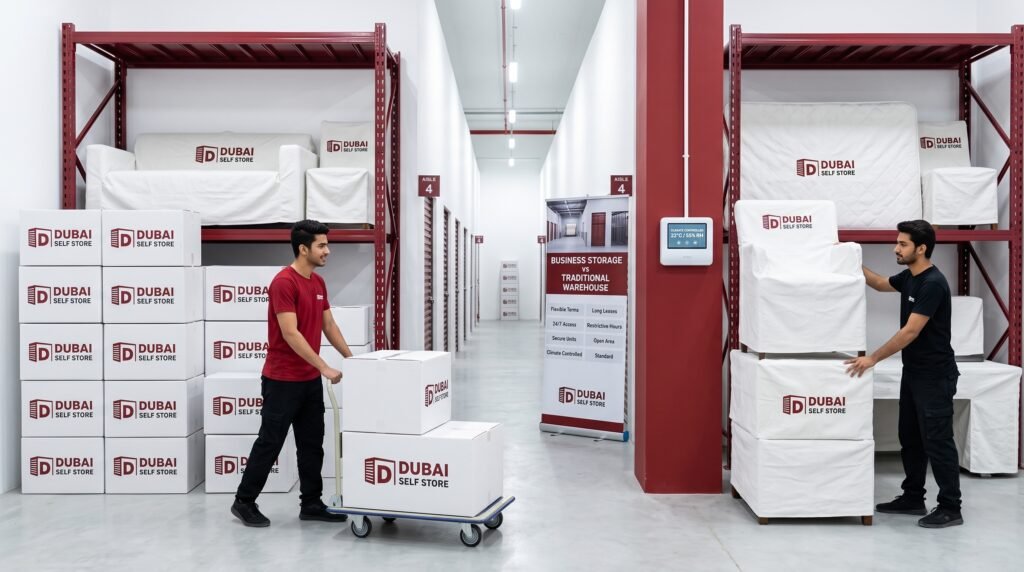
Self storage and warehouse rental solve different problems.
A self-storage unit is usually better when a company needs flexible space for a moderate amount of stock, documents or equipment. A warehouse becomes more appropriate when the operation involves pallets, frequent vehicle movements, regular receiving and dispatch, or dedicated staff working with inventory.
| Business requirement | Self storage | Warehouse space |
|---|---|---|
| Small or moderate stock volume | Suitable | May be excessive |
| Short-term requirement | Usually practical | Depends on lease terms |
| Archived documents | Suitable | Often unnecessary |
| Pallet handling | Limited at some facilities | More suitable |
| Frequent deliveries | Must be confirmed | Usually better equipped |
| Office furniture | Suitable | Suitable |
| Daily order fulfilment | Possible in some facilities | Often more practical |
| Flexible unit changes | Commonly available | May require lease changes |
Do not choose only by floor area. Ask how deliveries are handled, whether trolleys are available, how close the vehicle can get and whether the facility accepts pallets.
Commercial storage Dubai businesses use should support the actual workflow, not simply provide an empty room.
How Business Relocation Storage Works in the UAE
Relocation storage provides temporary space between the old premises and the new one.
The process usually begins with an inventory or site survey. The moving or storage team estimates the number of workstations, cartons, cabinets, computers and pieces of furniture involved. The business then decides what will go directly to the new office and what should remain in storage.
A typical relocation process includes:
- Categorising furniture, stock, documents and IT equipment
- Preparing a numbered inventory
- Booking building access and service lifts
- Packing items by department or destination
- Moving temporary items into storage
- Completing work at the new premises
- Delivering stored items in planned stages
- Reassembling furniture and checking the inventory
Relocation facilities in the UAE may provide packing, collection, storage, retrieval and final delivery under one quotation. Companies should still ask for each cost to be listed separately.
Businesses establishing or changing premises can also consult the officialInvest in Dubai business portal, which provides information about business activities, mainland and free-zone options, regulations and services for SMEs.
What Office Movers Mean in Dubai
Office movers in Dubai are teams that specialise in commercial relocations rather than ordinary household moves.
Their work can include:
- Packing workstations and office furniture
- Labelling computers and monitors
- Protecting servers and electronic equipment
- Handling archive cartons
- Dismantling boardroom tables
- Coordinating loading bays
- Reserving service lifts
- Following building moving hours
- Delivering items by floor or department
- Placing overflow furniture into storage
Dubai office moves often involve building management procedures. A tower may require an approved moving request, vehicle information, staff identification or a specific loading window.
Businesses new to office relocation should appoint one internal coordinator. That person should approve the inventory, communicate with building management and confirm where every item will go.
Without one decision-maker, movers receive conflicting instructions and boxes end up in the wrong departments.
A Simple Office Labelling System
Use a consistent code rather than writing employee names alone.
For example:
MKT-F12-WS07
This could represent the marketing department, floor 12, workstation 7.
Use the same code on the desk, chair, screen, cable bag and computer carton. The new office becomes much easier to rebuild.
How to Choose the Right Storage Unit Size
The best estimate comes from an inventory, photographs or a video survey. Business stock varies too much for unit size to be judged by carton count alone.
As a general guide:
| Approximate size | Typical business use |
|---|---|
| 25 sq ft | Documents, samples and a small number of cartons |
| 50 sq ft | Startup stock, supplies or spare office equipment |
| 100 sq ft | Moderate e-commerce stock or small-office contents |
| 150 sq ft | Larger inventory, furniture and archive cartons |
| 200 sq ft | Substantial SME stock or office relocation contents |
| 300 sq ft and above | Commercial inventory, equipment or multiple pallets |
The live self-storage unit size guide lists commercial bays from approximately 300 square feet and above for businesses with larger inventories, displays or equipment.
Leave room for movement. A unit filled completely from wall to wall may technically hold the stock, but it will be difficult to operate.
Business Storage Prices in AED
Storage prices in AED depend on the unit size, location, storage conditions, access requirements and rental duration.
Indicative monthly ranges are:
| Unit size | Standard storage | Climate-controlled storage |
|---|---|---|
| 25 sq ft | AED 150 to AED 280 | AED 200 to AED 360 |
| 50 sq ft | AED 280 to AED 450 | AED 380 to AED 580 |
| 100 sq ft | AED 500 to AED 750 | AED 650 to AED 950 |
| 150 sq ft | AED 750 to AED 1,100 | AED 950 to AED 1,400 |
| 200 sq ft | AED 1,100 to AED 1,600 | AED 1,400 to AED 2,050 |
| 300 sq ft and above | AED 1,800 to AED 3,500+ | AED 2,200 to AED 4,200+ |
These are budgeting ranges rather than fixed quotations. The current self storage Dubai prices guide shows that final rates vary by unit type, climate control and facility location.
Factors That Change the Final Cost
Ask whether the quotation includes:
- Collection and delivery
- Loading and unloading
- Packing materials
- Professional packing
- Pallet handling
- Insurance or contents cover
- Access cards or locks
- Deposits
- Additional employee access
- Retrieval charges
- Weekend visits
- Furniture assembly
- VAT
Businesses should confirm whether quoted prices include VAT and retain proper invoices for accounting purposes. Official UAE VAT information is available through theFederal Tax Authority.
A low monthly rate can become expensive when every retrieval, delivery or staff visit carries an additional fee.
Security and Access Systems to Check
Security for business storage is not limited to a padlock.
A suitable facility should explain how it protects the site, controls entry and records access. Review:
- CCTV coverage in entrances and shared areas
- Electronic access cards, PINs or biometric entry
- Individual unit locks
- Entry and exit logs
- Fire detection and suppression
- Alarm systems
- On-site or remotely monitored security
- Visitor authorisation procedures
- Pest-control schedules
- Lighting in corridors and loading areas
- Insurance requirements
The secure self storage Dubai guide identifies CCTV, electronic access, individual alarms and fire protection among the main security features businesses should verify. Not every facility offers the same combination, so these details should appear in the agreement.
Check Access Before Signing
Access terms can affect operations more than the monthly price.
Ask:
- Can several employees receive access?
- Is each user given a separate code?
- Can suppliers deliver directly?
- Is advance notice required?
- Are customers permitted inside after normal working hours?
- Can a courier collect an authorised carton?
- Are loading bays available on weekends?
- Is there space for commercial vehicles?
A facility advertised as monitored 24 hours a day may not provide customer access 24 hours a day. Those are two different things.
Imported and Regulated Goods Need Extra Care
Ordinary self storage is not automatically a customs warehouse.
Businesses importing stock that remains under customs control should confirm the correct legal and operational arrangement before moving goods into a facility. Dubai Customs provides a separate customs warehouse licensing process for goods stored under customs supervision.
The officialDubai Customs Services Guide is a useful reference for companies dealing with bonded or customs-controlled inventory.
Businesses storing chemicals, oils, batteries or other regulated materials should also check the facility’s prohibited-items policy and review relevantDubai Municipality technical guidelines.
Do not assume that a commercial unit can accept every type of product.
Practical Business Storage Examples in Dubai
Home-Based E-Commerce Seller in JVC
An online seller keeps products, mailers and returns inside a one-bedroom apartment. Orders are growing, but the business is not ready for a full warehouse.
A 50 or 100 square foot unit can separate business stock from living space. Products should be organised by SKU, with fast-moving items close to the front.
Retailer in Dubai Marina
A retailer has limited storage behind the shop and receives seasonal promotional stock several weeks early.
Temporary commercial storage prevents excess cartons from blocking staff areas. Products can be moved to the shop in smaller batches as needed.
Consultancy Moving from Business Bay
A consultancy must leave its current office before the new fit-out is complete.
Office movers transfer employee files, spare furniture and meeting-room equipment into storage. Computers required for remote work travel separately with authorised staff.
Contractor Working Across Dubai
A maintenance contractor owns ladders, boxed fittings, tools and protective equipment used on different projects.
A storage unit provides a central collection point. Shelving and a sign-out register make it easier to track equipment issued to each team.
Enterprise Renovating One Floor
A larger organisation is renovating part of its office while other departments remain operational.
Furniture and records are moved into storage floor by floor. Staged return delivery prevents the building’s loading bay from becoming overwhelmed when renovation ends.
Mistakes Businesses Commonly Make
The most common mistake is renting space without planning how it will be used.
Other avoidable problems include:
- Choosing a facility too far from daily operations
- Storing unlabelled cartons
- Keeping confidential files beside general stock
- Blocking the unit entrance with slow-moving goods
- Allowing shared access through one PIN
- Failing to record incoming and outgoing inventory
- Ignoring climate requirements
- Assuming deliveries are accepted automatically
- Forgetting retrieval and transport charges
- Using a small unit beyond its practical capacity
- Storing prohibited or hazardous materials
- Signing without reading the cancellation terms
Treat the unit as part of the business operation. Keep it organised, audited and accessible.
Final Business Storage Checklist
Before booking company storage in the UAE, confirm:
- The amount and type of stock being stored
- The required unit size
- The expected rental period
- Access frequency
- Employee permissions
- Delivery and loading arrangements
- Climate-control requirements
- Security and fire-protection systems
- Insurance limits
- Prohibited items
- Collection and retrieval fees
- VAT and deposit terms
- Notice required to leave or change units
Business storage works best when it removes pressure from the company rather than creating another unmanaged space.
For a growing SME, that may mean moving twenty cartons out of a home office. For an enterprise, it may mean coordinating hundreds of labelled assets during a phased relocation.
The scale changes. The principle does not.
Pay for the space the business needs, organise it around real operations and make sure access, security and pricing are clear before anything is moved.
Frequently Asked Questions
Business storage is rented space for commercial inventory, documents, equipment, packaging materials and office furniture. It can be used for short-term overflow, long-term storage or an office relocation.
Small units may cost approximately AED 150 to AED 450 per month. Medium and large business units generally range from AED 500 to AED 2,050, while commercial spaces of 300 square feet or more may start around AED 1,800 per month.
It can be more economical for SMEs with moderate stock levels or temporary requirements. A warehouse may be more appropriate for pallet handling, frequent dispatch and large-scale operations.
A storage unit can hold products, returns and packaging materials, but operating activities depend on the facility’s rules and the company’s licence. Confirm whether deliveries, employee access and order collection are permitted.
Some facilities allow multiple authorised users. Ask whether each employee receives an individual access code and whether entry activity is recorded.
It is recommended for electronics, documents, wooden products, leather, fabrics and goods sensitive to heat or humidity. Durable packaged products may not always require it.
Yes. Desks, chairs, cabinets, meeting tables and boxed equipment can be stored until the new office is ready. Furniture should be cleaned, dismantled where practical and protected before transport.
Facilities generally prohibit explosives, flammable materials, perishable food, illegal goods and hazardous chemicals. Restrictions vary, so businesses should review the rental agreement before moving stock.