
Self Storage Mistakes Dubai Renters Make (and How to Avoid Them)
Most self storage problems in Dubai do not begin after you move your belongings into a unit. They begin before you book one. Choosing a unit that is too large, ignoring access rules, assuming insurance is automatically included, overlooking summer heat, or signing a contract without checking the notice period can turn a useful storage arrangement into an expensive nuisance.The good news is that most of these mistakes are easy to avoid.
The safest approach is simple: choose the right amount of space, understand the contract, match the storage environment to your belongings, check security properly, and know exactly what you are paying for before moving anything in.
That sounds obvious. Yet storage decisions are often made under pressure. Tenancy is ending. Renovation starts tomorrow. A flight is booked. Furniture needs to disappear from the living room before contractors arrive. That is when people skim the details. And that is usually when the trouble starts.
This guide covers the ten self storage mistakes Dubai renters make most often and, more importantly, what to do instead. Each mistake also points toward the dedicated guide that explains the solution in greater depth.
The 10 Self Storage Mistakes Dubai Renters Make
1. Choosing the wrong storage unit size
The first mistake is also one of the easiest ways to waste money: renting more space than you actually need. People often look around a furnished apartment and imagine everything needs the same floor area inside a storage unit. It usually does not. Furniture can be dismantled, boxes stacked safely, and vertical space used far more efficiently.
The opposite problem happens too. A unit that is too small can force awkward stacking, block access, or require an unexpected upgrade after you arrive. Before booking, list what you are storing and estimate its packed volume rather than guessing from room size. That’s why you should choose unit size wisely.
2. Skipping climate control for heat-sensitive belongings
Not every item needs climate-controlled storage, but assuming nothing does can be an expensive mistake in Dubai. Electronics, documents, photographs, artwork, leather, wooden furniture and other sensitive belongings may react badly to prolonged heat or humidity, especially when stored for months rather than days.
The important question is not, “is climate control better?” Of course a controlled environment offers more protection. The better question is whether the additional protection is justified by the item type, storage duration and replacement value. Do not pay extra automatically, but do not save a small amount on the unit while exposing expensive belongings to avoidable damage.
3. Ignoring deposits, VAT and additional charges
A monthly storage price tells you only part of the story. A renter may see an attractive advertised rate, calculate several months of storage and assume that is the total commitment. Then come the extras: security deposit, VAT where applicable, transport, packing, insurance, access-related charges or other service fees depending on the provider and package.
None of these charges is automatically unreasonable. The mistake is discovering them after making the decision. Ask for a clear written breakdown before paying anything. Know the base rental amount, what is included, what is optional, what is refundable and what may be charged when you move out.
4. Trying to store prohibited or unsuitable items
A storage unit is extra space. It is not a place where absolutely anything can be kept. Storage providers may restrict flammable materials, hazardous substances, illegal goods, weapons, perishable food, live plants and other items that create safety, legal or hygiene problems. There may also be belongings that are technically allowed but simply unsuitable for a particular storage environment.
Do not assume acceptance just because an item fits through the door. Check the prohibited-items policy before packing. This is especially important for business stock, chemicals, food-related products, batteries or materials that may be classified differently from ordinary household belongings.
5. Choosing a facility with weak security
A shiny reception area does not tell you much about how your belongings are protected at 2 a.m. Security deserves a proper look. Check how access is controlled, whether the facility uses CCTV, whether units are individually secured, how visitors enter, how the site is monitored and what procedures exist if an access or security issue occurs. Also remember that “24/7 CCTV” and “24/7 access” are not the same thing.
Many renters skim security claims because every facility sounds secure in advertising. Look at the actual system instead. If you would feel uncomfortable leaving your belongings there after seeing how access works, a low monthly rate should not change your mind.
6. Missing the notice period before moving out
This mistake often happens at the end of an otherwise trouble-free storage rental. You decide you no longer need the unit. You empty it. You assume the contract ends. Then you discover that the agreement required advance notice. Storage contracts may have different renewal, cancellation and notice terms, so renters should never assume that moving their belongings out automatically stops future charges. Before signing, find the section explaining termination.
How much notice is required?
Does notice need to be written?
When does billing stop?
Are partial periods refundable?
A two-minute contract check can prevent a very irritating final invoice.
7. Assuming your belongings are automatically insured
A secure facility reduces risk.It does not make risk disappear. Fire, water damage, accidental damage, theft-related incidents and other losses are exactly why insurance questions matter. Yet many renters assume either that the storage company automatically insures everything or that their existing household policy will cover belongings wherever they are stored.
Neither should be assumed. Ask what protection is included, what is optional, which events are covered, what exclusions apply, and how claims are handled. For higher-value items, keep receipts, photographs or other evidence of ownership where practical. Insurance sounds boring until the day you need it. Then suddenly it becomes the most interesting paragraph in the contract.
8. Packing and stacking everything badly
A secure storage unit cannot protect belongings from careless packing. Heavy boxes stacked on fragile ones, unprotected furniture edges, loose glassware, overfilled cartons and wardrobes stored without proper preparation can all cause damage even when the storage environment itself is perfectly fine. Pack according to the item. Use sturdy cartons. Protect delicate surfaces. Disassemble suitable furniture. Keep heavy items low and lighter boxes higher. Avoid leaning unstable objects where they can fall when the unit is opened. And leave some access space if you expect to retrieve anything during the rental period. Good storage starts with good packing, not with closing the unit door.
9. Moving everything in without an inventory list
You may think you will remember what is in storage. You probably will. For about two weeks. After several months, “three boxes of kitchen stuff” becomes a surprisingly vague description when you need one particular coffee machine, tenancy document or set of winter clothes. Create a simple inventory before the move.
You do not need specialist software. A phone note, spreadsheet or numbered box list is enough. Label boxes clearly and match the labels to the inventory. For larger units, record roughly where important items are placed. That little bit of organisation prevents you from opening twelve boxes to find the thirteenth thing.
10. Choosing a storage company on price alone
Cheap storage is not always poor storage. Expensive storage is not automatically excellent either. The mistake is making price the only comparison. A storage unit is useful only if the facility, access, security, unit type, contract terms and service arrangement match what you need.
A lower rate may be good value for long-term furniture you rarely access. The same facility may be inconvenient for business stock you need several times each week. Compare the whole offer. Look at location, access, security, unit condition, customer support, collection options, contract flexibility and what is actually included in the quoted price. Before making an exact choice, you should have full knowledge about how to choose a self storage company in Dubai.
Why these storage mistakes happen so easily
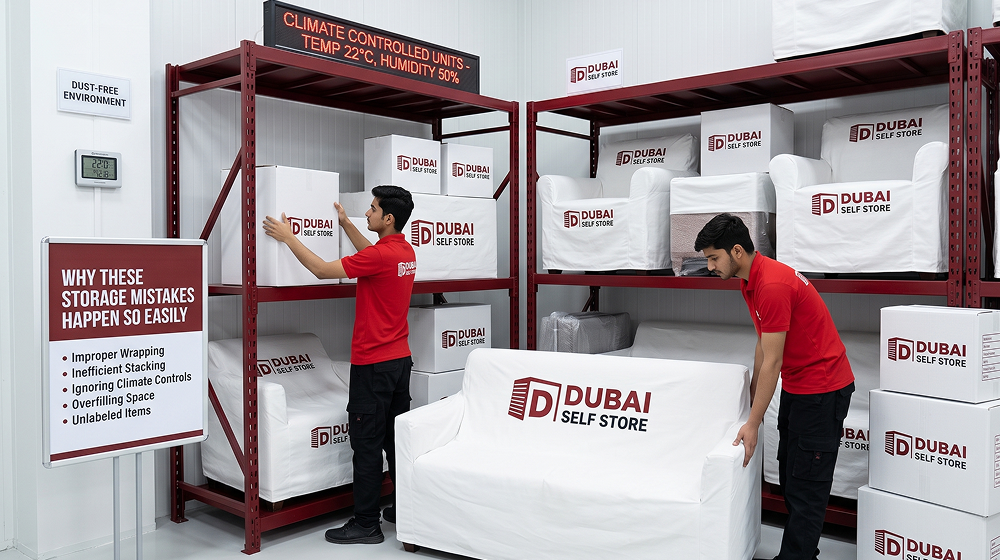
Most people do not rent self storage as a hobby. They rent it because something else is happening.
- They are moving.
- Their tenancy is ending.
- Their villa is being renovated.
- They are leaving Dubai temporarily.
- Their office is overcrowded.
- Their stockroom is full.
These situations create urgency, and urgency encourages shortcuts. A renter who would normally compare several options may suddenly book the first available unit because the movers are arriving tomorrow morning. That does not necessarily lead to disaster. But it increases the chance of choosing the wrong size, missing a contract condition or paying for a feature that does not suit the items being stored. The solution is not endless research. You do not need to spend three days comparing storage facilities like you are buying commercial property. You just need to answer the right questions in the right order. Start with the belongings. Then the unit. Then the facility. Then the contract. Then the final price.
People often reverse that sequence. They start with:
“Which storage company is cheapest?”
That question comes too early. A cheap 100 sq. ft. unit is not a bargain if you only need 50 sq. ft. A standard unit is not good value if sensitive belongings require better environmental protection. A secure facility across the city may not suit a business that needs regular stock access. A flexible monthly rate may still become inconvenient if you did not notice the cancellation terms. Price matters after suitability, not before it.
The one-page pre-rental checklist
Use this checklist before paying a deposit or moving your belongings into storage. It is intentionally simple. You should be able to run through it in a few minutes.
What am I actually storing?
Write down the main categories.
- Furniture?
- Boxes?
- Documents?
- Business inventory?
- Electronics?
- Clothes?
- Artwork?
- Appliances?
- Seasonal items?
If the answer is simply “everything,” sort first. Storage costs are partly driven by how much space you occupy, so removing unnecessary belongings before booking can immediately improve the decision.
Check: I have separated items to keep, sell, donate and dispose of.
Do I know the approximate unit size I need?
Do not choose a size purely because a facility labels it “good for a one-bedroom apartment.” Two one-bedroom apartments can contain completely different amounts of furniture. Estimate your actual belongings. Think vertically as well as horizontally. Ask whether large furniture can be dismantled safely and whether boxes can be stacked.
Check: My unit size is based on the items being stored, not only my property size.
Do any of my belongings need climate control?
Review sensitive items individually. Documents and electronics do not have the same storage requirements as plastic garden chairs. Neither do leather sofas, artwork or wooden furniture. Think about duration too. A short storage period and a year-long storage period create different levels of exposure.
Check: I have matched the storage environment to the belongings rather than automatically choosing the cheapest unit.
Have I checked what cannot be stored?
Ask the provider for its prohibited-items rules. Do this before movers arrive. Seriously. Discovering at the storage facility that one category of your belongings cannot be accepted is the sort of problem that becomes funny several months later. Not on moving day.
Check: None of my planned items conflicts with the facility’s storage policy.
Have I checked the actual security setup?
Look beyond generic claims. Ask about access control. Ask about CCTV. Ask how individual units are secured. Check whether staff are present, where relevant, and how entry to the storage areas works. If you are storing business goods or higher-value personal belongings, this deserves more than a quick glance.
Check: I understand how people enter the facility and how my individual unit is protected.
Do I understand the full price?
Ask for the total initial amount and the ongoing rental cost.
Check:
- Base unit rental
- Security deposit
- VAT, where applicable
- Insurance
- Transport
- Packing
- Collection
- Delivery
- Access-related charges
- Optional services
- Move-out charges, if any
Do not mentally convert “from AED X” into “my final price is AED X.” “From” is doing quite a lot of work in that sentence.
Check: I have a written breakdown of what I will actually pay.
Do I understand the billing cycle?
Monthly rental can mean different things depending on the contract. Ask when the billing period begins and ends. Ask how renewals work. Check whether payment is automatic. Understand what happens if you stay beyond your original planned period.
Check: I know when I am billed and how the rental renews.
Have I checked the notice period?
Find out how far in advance you need to cancel. Do not leave this question until moving day. If notice must be provided in writing, know where it should be sent and what counts as accepted notice.
Check: I know exactly how to end the rental without unnecessary extra billing.
Are my belongings insured?
Ask whether insurance is included. If not, ask whether it is available. If you have your own policy, confirm whether off-site storage is actually covered rather than assuming it is. For valuable belongings, keep a basic record of what you put into storage.
Check: I understand the level of insurance or protection applying to my stored items.
Have I packed properly?
- Do not use weak boxes for heavy goods.
- Do not stack delicate items underneath furniture.
- Do not place unprotected wood directly against potentially damaging surfaces.
- Do not leave fragile objects loose.
- And do not assume that because professional movers handled transportation, the items are automatically prepared for long-term storage.
Moving and storing are related jobs, but they are not identical jobs.
Check: My belongings are packed for storage duration and item type.
Have I labelled everything?
Use clear labels. “Kitchen” is better than nothing. “Kitchen (coffee machine, blender, glass containers)” is much better. Numbering boxes makes inventory management easier. For business storage, labels become even more important when several people may need to retrieve stock or records.
Check: Every box can be identified without opening it.
Can I reach the items I am likely to need?
Think about retrieval before stacking. Items you will not touch until move-out can go deeper into the unit. Things you may need next month should not be buried behind a wardrobe, six chairs and thirty-four boxes. reate a simple access path if the unit size allows it.
Check: Frequently needed items are stored near the front.
Do I have a basic inventory?
Record what entered the unit. For a small unit, a simple numbered list is enough. For larger household or business storage, you may also want to note where groups of items are positioned. Take photographs if useful. The objective is not bureaucracy. It is avoiding the sentence: “I know it’s in here somewhere.”
Check: I can identify what is stored without physically searching every box.
Have I compared more than price?
Compare at least the factors that affect your actual use.
For example:
- If you need frequent access, location matters more.
- If you are storing furniture during travel, long-term price and protection may matter more.
- If you are storing records, organisation and environment may matter more.
- If you are storing expensive belongings, security and insurance rise in importance.
- There is no universally “best” storage company.
Check: I selected the facility based on suitability, not only the lowest advertised rate.
A better way to choose storage in Dubai
If you remember only one thing from this guide, make it this: Do not choose the storage unit first. Choose the storage requirement first. Start by asking what problem you are trying to solve. Maybe your furniture needs somewhere safe for four months while a renovation is completed. Maybe your apartment is full of belongings you use only seasonally. Maybe you are leaving the UAE temporarily.
Maybe your company needs off-site space for records. Maybe you need an extra unit because you genuinely own more things than your current property can reasonably hold. Once the problem is clear, the storage decision becomes far easier.
You can determine the required size. Then the environment. Then the security level. Then the access pattern. Then the contract. Then the price. That order protects you from most of the mistakes on this page. It also stops you buying features you do not need.
A household storing ordinary furniture for a short period may not require the same arrangement as a business storing sensitive documents for several years. Someone who visits a unit twice per week has different needs from someone who plans to lock it for six months and leave the country. Context matters.
One final check before you sign
Stand in front of the agreement, quotation or booking page and ask yourself five questions:
- Do I know what I am storing?
- Do I know why I am storing it?
- Do I know how long I am likely to store it?
- Do I understand the total cost and exit terms?
- Does this facility actually suit these belongings?
If you can answer all five without guessing, you have already avoided most common self storage mistakes. If you cannot, do not rush because a promotional rate expires tonight. Fix the missing information first. Storage should make your life simpler. That is the point.
The wrong unit, weak packing, vague pricing or an unread contract can do the opposite. But with a little preparation, self storage in Dubai can remain exactly what it is supposed to be: useful extra space when and where you need it.