Storage Deposits, VAT, and Hidden Fees in Dubai
When renting self storage in Dubai, your final cost can include the monthly unit rent, a security deposit that is often around one month of rent, 5% VAT on taxable charges, and possible extras such as administration, access cards, locks, insurance, pickup and delivery. The important part is knowing which fees apply to your rental, when they are charged, and whether they are optional or unavoidable before you sign the contract.
The monthly self storage price in Dubai is usually the number people notice first. It might say AED 300, AED 500 or AED 800 per month. That number matters, but it is not always the amount that leaves your bank account on day one.
You may also need to pay a refundable deposit. VAT may be added to taxable charges. Some facilities charge for an access card, while others may include it. A lock may be your responsibility, insurance may be optional or separately arranged, and pickup or delivery can add another charge if you use those services.
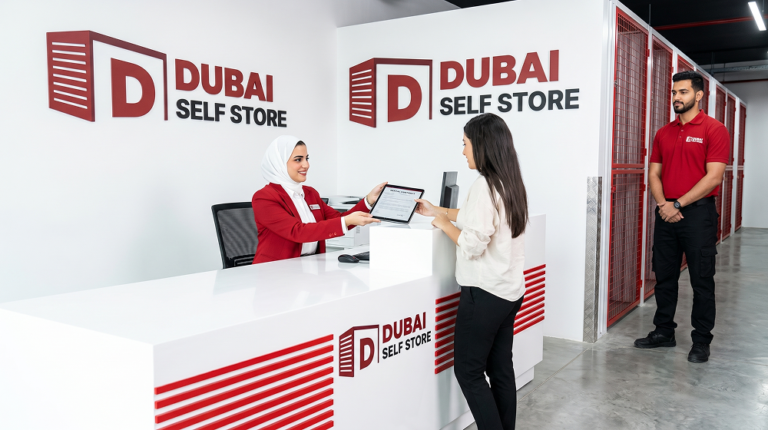
None of these automatically make a storage facility expensive. The problem is not knowing about them until you’re ready to move in. A good storage quote should make the full cost easy to understand. Before paying anything, ask for an itemised breakdown showing the monthly rent, VAT, deposit, one-time charges and optional services.
What Extra Fees Apply to Self Storage in Dubai?
The extra fees you may encounter when renting storage in Dubai generally fall into a few categories: security deposit, VAT, administration charges, access-card or access-related fees, lock costs, insurance or contents protection, and transportation services such as pickup and delivery.
Not every facility charges all of these. Some include certain costs in the advertised rental price, while others bill them separately. That is why comparing two storage companies purely by their monthly rent can produce a misleading result.
For example, imagine one provider quotes AED 500 per month and another quotes AED 550. The AED 500 provider may look cheaper until you discover that the first quotation excludes a separate access-card fee and charges for pickup. If the AED 550 provider includes those items, the difference may be much smaller than the headline prices suggest. The safest approach is to ask for the total move-in cost and recurring monthly cost separately.
Typical storage fee checklist
| Fee | Amount | When charged | Avoidable? |
|---|---|---|---|
| Monthly storage rent | Depends on unit | Monthly | No |
| Security deposit | Often around one month’s rent | At move-in | Usually no, if required |
| VAT | 5% on taxable charges | With applicable invoice | No, where applicable |
| Administration fee | Varies by provider | Usually at setup | Sometimes |
| Access card/key | Varies | At setup/replacement | Sometimes |
| Padlock | Varies | At move-in | Often, depending on provider |
| Insurance/contents cover | Varies | Monthly or annually | Depends on arrangement |
| Pickup | Varies | When requested | Yes |
| Delivery | Varies | When requested | Yes |
| Retrieval/handling | Varies | When requested | Sometimes |
These are categories to check, not a claim that every Dubai storage provider charges every fee. The actual amount should come from the provider’s quotation and rental agreement. That distinction is important when comparing storage prices.
How Much Is the Security Deposit?
A security deposit is commonly around one month’s rent, although the exact amount depends on the storage provider and the terms of the rental agreement. For example, if your monthly storage rent is AED 600 and the provider requires a one-month deposit, your deposit would be AED 600.
Your initial payment could therefore look like:
AED 600 monthly rent + AED 600 deposit = AED 1,200 before any applicable VAT or other charges.
The deposit is not normally the same thing as another month of storage rent. Its purpose is to provide the provider with financial protection against issues covered by the contract, such as unpaid amounts or damage where the agreement makes the customer responsible.
The important question is not simply, “How much is the deposit?”
Ask:
Is it refundable?
When is it returned?
What can be deducted from it?
Is the deposit subject to VAT?
Does the contract specify the refund process?
These details matter because a deposit can make the amount you need at move-in significantly higher than the advertised monthly rent.
Example: AED 500 storage unit
Suppose a storage unit costs AED 500 per month and the provider requires a one-month security deposit. Your basic move-in calculation is:
| Item | Amount |
|---|---|
| First month’s rent | AED 500 |
| Security deposit | AED 500 |
| Initial total | AED 1,000 |
If VAT applies to the taxable rental charge at 5%, AED 25 would be added to the AED 500 rent, giving a total of AED 1,025 before considering any other applicable charges.
The deposit treatment should be confirmed from the contract and invoice rather than assumed. This is why a quote that says “from AED 500/month” does not necessarily mean you only need AED 500 on the day you move in. You may need more cash upfront.
How Does 5% VAT Apply to Storage in Dubai?
The UAE’s standard VAT rate is 5% for taxable supplies. The Federal Tax Authority explains that VAT is generally charged at 5% unless a particular supply is exempt or zero-rated. For a taxable storage rental, the simple calculation is:
Monthly price × 5% = VAT
So, if your storage rent is AED 600:
AED 600 × 5% = AED 30 VAT
Your total becomes:
AED 630
If the unit costs AED 1,000 per month:
AED 1,000 × 5% = AED 50 VAT
Your monthly total becomes:
AED 1,050
The calculation is straightforward. What sometimes causes confusion is whether the advertised price already includes VAT.
Suppose one provider advertises AED 600 including VAT, while another advertises AED 600 + VAT.
They are not offering the same final price.
The first quote remains:
AED 600
The second becomes:
AED 600 + AED 30 = AED 630
That is a AED 30 difference every month.
Over 12 months:
AED 30 × 12 = AED 360
Not huge, perhaps, but certainly worth knowing before comparing quotes.
VAT comparison
| Advertised taxable rent | 5% VAT | Total including VAT |
|---|---|---|
| AED 300 | AED 15 | AED 315 |
| AED 500 | AED 25 | AED 525 |
| AED 600 | AED 30 | AED 630 |
| AED 800 | AED 40 | AED 840 |
| AED 1,000 | AED 50 | AED 1,050 |
| AED 1,500 | AED 75 | AED 1,575 |
Always check whether the provider’s published price is VAT-inclusive or VAT-exclusive. If you are comparing storage companies, use the same basis for every quote. Otherwise, you could mistakenly choose the provider that only appears cheaper.
What Hidden or One-Time Fees Should You Expect?
The phrase “hidden fees” makes storage sound more mysterious than it really is. Most charges are not necessarily hidden. They are simply not included in the basic monthly rental price. That is why asking the right questions before signing matters. Administration, access cards, locks, insurance and transportation are common areas where customers should ask for clarification. The amount varies from provider to provider, so do not assume that a particular fee will apply to every facility.
Admin and Access-Card Fees
Some storage facilities may charge an administration or setup fee when creating a new rental account. Others may include account setup in the standard rental price. Access-related charges can work in a similar way.
A facility may issue an access card, key or another access credential as part of the rental. Replacement credentials may carry a charge if the original is lost or damaged. The important thing is to ask about both initial and replacement costs. Imagine an access card costs AED 50. That may seem insignificant next to a year’s storage rent, but you would rather know about it before moving in than discover it after losing the card.
Ask the provider:
- “Is the access card included?”
- “If I lose it, what is the replacement fee?”
- “Is there an administration or account setup fee?”
These are small questions that can prevent awkward surprises later.
Typical treatment: varies by facility.
When charged: usually at setup or when a replacement is required.
Avoidable: sometimes, depending on the provider and circumstances.
Padlock and Insurance
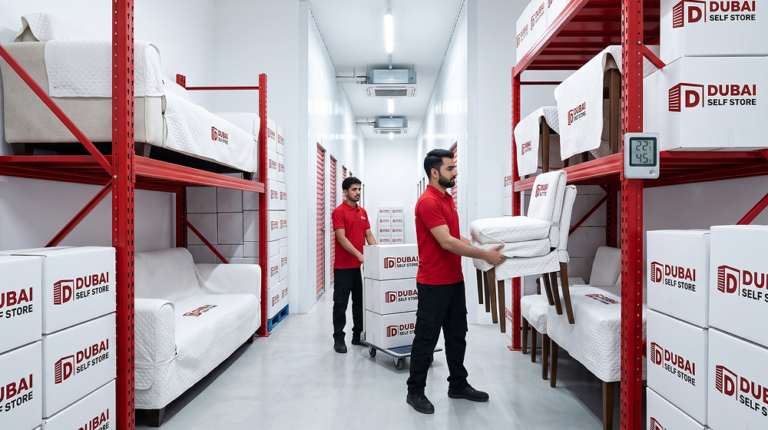
A storage unit needs appropriate protection against unauthorized access, but the exact lock arrangement depends on the facility. Some storage providers may supply or require a particular type of lock. Others may expect customers to provide their own padlock. If you need to purchase a lock, treat it as a one-time setup expense, not part of your monthly storage rent. Insurance is different.
Some customers assume that their household or business insurance automatically covers goods stored in a commercial storage facility. Before renting a unit, it is worth understanding what self storage insurance in Dubai covers and whether you need separate protection for furniture, electronics, documents or business inventory. Some facilities may offer contents protection or insurance as an additional service, while others may require customers to arrange their own cover. The important question is:
“Are my stored belongings insured, and if so, under what terms?”
Do not assume that security and insurance mean the same thing. A facility can have access controls and security systems while the customer remains responsible for arranging appropriate insurance cover.
What to check
| Item | What to ask |
|---|---|
| Padlock | Is one provided or do I supply my own? |
| Replacement lock | What happens if it is lost or damaged? |
| Insurance | Is the contents cover included? |
| Existing insurance | Does my policy cover commercial storage? |
| Optional cover | Can additional protection be purchased? |
Typical treatment: varies significantly.
When charged: at move-in or periodically if insurance is purchased.
Avoidable: insurance may depend on your existing cover and the provider’s requirements; a required lock may not be optional.
Pickup and Delivery Charges
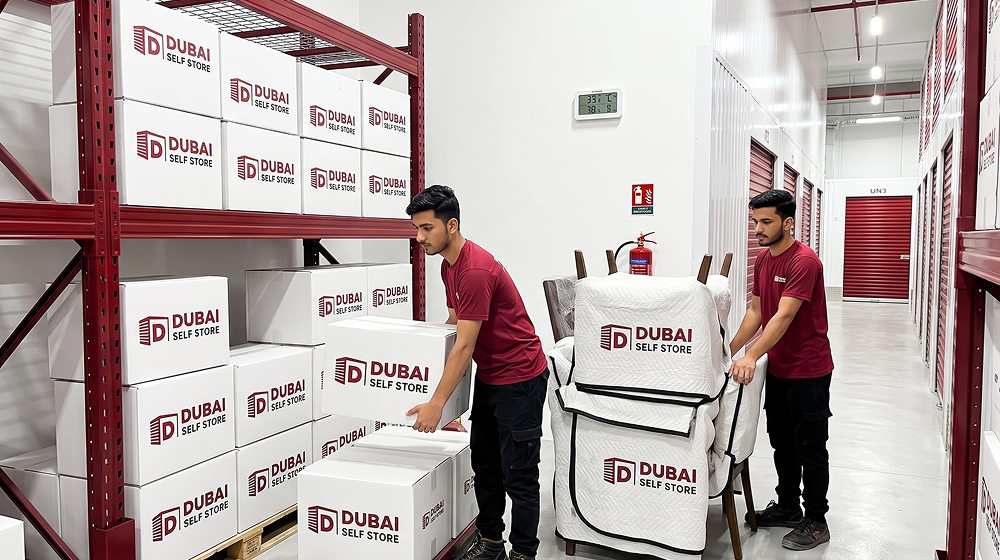
Pickup and delivery can be one of the most useful storage services in Dubai, particularly if you are moving furniture, relocating an office or storing belongings that are difficult to transport yourself. They can also increase your total storage budget.
For example, imagine a pickup charge of AED 150. If you use it four times during a year, your transportation spend becomes:
AED 150 × 4 = AED 600
That AED 600 is separate from your monthly storage rent. This does not mean pickup is a bad deal. If you would otherwise need to hire a van, pay a driver and spend several hours moving furniture yourself, the storage provider’s service could be worth every dirham. The key is to include transportation when calculating your real annual storage cost. If you expect to use pickup only once when moving into storage, it is a one-time expense. If you’re running a business and need regular deliveries, it becomes an ongoing operational cost.
Example
Suppose:
Storage rent: AED 600/month
VAT: AED 30/month
Pickup: AED 150 once
For the first month, your basic cost would be:
AED 600 + AED 30 + AED 150 = AED 780
Your normal monthly cost after that would be AED 630, assuming no other charges apply. That is very different from assuming the entire rental costs AED 780 every month. Clear itemisation prevents this kind of confusion.
Typical treatment: charged when the service is requested.
Avoidable: yes, if you can move the items yourself and the provider does not require its transportation service.
Can You Get No-Deposit Storage in Dubai?
No-deposit storage may be available from some providers or under certain promotions, but it should never be assumed from the advertised monthly price. Whether a deposit is required depends on the storage company’s rental terms. If avoiding a large upfront payment is important, ask directly:
“Do you require a security deposit?”
If the answer is yes, ask how much it is and under what circumstances it is refunded. If the provider offers a no-deposit option, check whether the absence of a deposit comes with another condition, such as a different rental rate, payment structure or minimum rental period. This matters because no deposit does not automatically mean cheaper storage.
Consider two examples.
Option A
Monthly rent: AED 600
Deposit: AED 600
Initial payment before applicable VAT and extras: AED 1,200
Option B
Monthly rent: AED 650
Deposit: AED 0
Initial payment before applicable VAT and extras: AED 650
Option B requires less money upfront.
But over 12 months:
Option A: AED 600 × 12 = AED 7,200
Option B: AED 650 × 12 = AED 7,800
The no-deposit option costs AED 600 more in rental over the year. Of course, the deposit in Option A may be refundable, so the comparison is not simply “AED 1,200 versus AED 650.” The deposit is tied up temporarily rather than necessarily being a permanent expense. That is why you should distinguish between: Upfront cash required and Total rental cost. They are not the same thing.
How Do You Get Every Fee Itemised on the Contract?
The easiest way is to ask for a written quotation or rental agreement that separates recurring charges, one-time charges, refundable amounts and optional services. Do not settle for a sentence that simply says:
“Storage: AED 600/month.”
Ask for a breakdown. A useful fee summary should look something like this:
| Charge | Amount | Frequency | Refundable? | Included? |
|---|---|---|---|---|
| Storage rent | AED ___ | Monthly | No | Yes |
| VAT | AED ___ | Monthly/as applicable | No | ___ |
| Security deposit | AED ___ | Once | ___ | ___ |
| Administration | AED ___ | Once | No | ___ |
| Access card | AED ___ | Once | No | ___ |
| Replacement card | AED ___ | If required | No | ___ |
| Padlock | AED ___ | Once | No | ___ |
| Insurance/contents cover | AED ___ | Monthly/annual | No | ___ |
| Pickup | AED ___ | Per service | No | Optional |
| Delivery | AED ___ | Per service | No | Optional |
| Retrieval/handling | AED ___ | Per service | No | ___ |
The blank spaces are intentional here because these charges are provider-specific. A responsible comparison should use the actual amounts quoted by the storage company rather than inserting generic figures and treating them as universal Dubai rates. This also gives you something useful to compare.
If Provider A charges AED 600 per month and Provider B charges AED 550, put both quotations into the same table. Add VAT. Add the deposit separately. Add any setup costs. Then include the transportation services you genuinely expect to use. You may discover that the AED 550 provider is not actually cheaper. Or you may discover that it is. Either way, you are making the decision using the real numbers.
What Should You Pay on Move-In Day?
Your initial payment can be higher than your normal monthly storage bill because it may include the first month’s rent, a refundable deposit and one-time charges. For example, suppose a unit costs AED 600 per month, VAT is 5%, and the provider requires a one-month security deposit. The basic calculation could be:
First month’s rent: AED 600
VAT on taxable rent: AED 30
Security deposit: AED 600
Initial total: AED 1,230
If there is also a AED 50 administration charge and a AED 40 lock purchase, your move-in cost becomes:
AED 1,230 + AED 50 + AED 40 = AED 1,320
That does not mean your storage costs AED 1,320 every month. The recurring rental cost is still AED 630 in this example, assuming no other monthly charges apply. This is why it is useful to ask the provider for two separate numbers:
“How much do I need to pay upfront?”
and
“How much will I pay every month after move-in?”
Those questions are surprisingly effective at exposing unclear pricing.
How to Compare Storage Quotes Without Missing a Fee
When you receive quotations from two or more storage providers, put them side by side. Do not compare the monthly rent alone. Start with the unit size. A 50 sq ft unit and a 100 sq ft unit cannot be compared purely by monthly price because they provide different amounts of space. Then check whether VAT is included. If one provider quotes AED 600 including VAT and another quotes AED 600 before VAT, the second provider actually costs AED 630 if the full 5% VAT applies.
After that, check the deposit. A refundable deposit affects your upfront cash requirement, even though it may not be a permanent rental expense. Finally, look for the extras: administration, access credentials, locks, insurance and transportation. A simple comparison might look like this:
| Cost | Provider A | Provider B |
|---|---|---|
| Monthly rent | AED 600 | AED 550 |
| VAT | AED 30 | AED 27.50 |
| Deposit | AED 600 | AED 550 |
| Admin fee | AED 0 | AED 75 |
| Lock | Included | AED 40 |
| First pickup | AED 150 | AED 0 |
| Initial cash requirement | AED 1,380 | AED 1,242.50 |
In this example, Provider B still requires less money upfront, but the difference is not simply AED 50 per month. The other charges change the picture. Over a longer rental, the monthly rate may become more important. For a short-term rental, one-time fees can have a much bigger impact on your effective cost. That is why the right comparison depends on how long you plan to rent.
What Is the Best Way to Avoid Storage Fee Surprises?
Ask for the complete cost before you move anything. A good checklist is simple. Confirm the monthly rent, whether VAT is included, the security deposit and refund conditions, administration fees, access-card costs, lock requirements, insurance arrangements, and the price of any pickup or delivery service you expect to use. Then ask whether there are any other charges that could appear during the rental. That final question is worth asking exactly as written:
“Are there any other mandatory or conditional fees that I should know about before signing?”
It gives the provider an opportunity to explain charges you may not have thought to ask about. Also read the contract before paying the deposit. Customers can also review Dubai’s officialconsumer rights guidance for information about transparency and consumer protection when dealing with service providers. The agreement should tell you what you are renting, how much it costs, when payments are due, what happens when you move out and what conditions apply to the deposit. If something in the contract does not match the quotation, stop and ask for clarification. A few minutes of checking at the beginning is much easier than disputing a charge later.
The Real Cost of Storage Is the Number on the Final Invoice
A cheap monthly storage rate is useful, but it only tells part of the story. The real cost can include the monthly rent, VAT, a security deposit, setup charges, access credentials, a lock, insurance and transportation. Some of those are recurring, some are one-time costs, and some are completely optional. That is why the best storage comparison is not:
“Which company has the lowest monthly price?”
It is:
“Which company gives me the storage I need at the clearest total cost?”
Dubai Self Store publishes storage pricing starting from AED 150/month, giving customers a starting point when researching storage costs in Dubai. Actual pricing can vary according to unit size, availability and storage requirements, so the current quotation should always be checked before booking.
If you are comparing a storage option, ask for the complete fee breakdown before committing. Once the rent, VAT, deposit and additional charges are sitting in front of you, the decision becomes much easier. A transparent storage quote should tell you exactly what you are paying, when you are paying it, and which charges you can choose to avoid.