Dubai Storage Size Calculator: Studio, 1BR, 2BR, Villa

Not sure whether you need 25, 50, 100, 150 or 200 sq ft of storage in Dubai? A good starting point is 25–50 sq ft for a studio, 50–100 sq ft for a 1-bedroom apartment, 100–150 sq ft for a 2-bedroom apartment, and 150–300+ sq ft for a villa. The exact size depends on how much furniture you have, how many boxes you are storing, whether items can be dismantled, and how often you need to access them.
The easiest way to avoid paying for space you don’t need is to estimate your storage requirement before booking. That’s where a storage size calculator helps. Instead of guessing from the number of bedrooms alone, you can combine your home type with furniture volume, boxes and access requirements to get a more realistic starting point.
A calculator is not meant to replace a quote from a storage provider. It gives you a sensible range to work from. Once you know roughly what you need, you can compare the available unit dimensions, prices and storage conditions and then confirm the final size with the provider.
Dubai Storage Size Calculator
Use the calculator below to get a starting estimate based on your property and belongings. The result should be treated as a planning recommendation because actual storage units can differ in shape, ceiling height, door position and usable layout.
Choose Your Home Type
Studio apartment: Start with 25–50 sq ft, depending on furniture and boxes.
1-bedroom apartment: Start with 50–100 sq ft, with 100 sq ft often more practical for a normally furnished home.
2-bedroom apartment: Start with 100–150 sq ft, depending on the amount of furniture and household contents.
3-bedroom apartment: Start with approximately 150–200 sq ft for a normally furnished property.
Villa: Start with 150–300+ sq ft, but use an inventory-based estimate because villas vary significantly in size and contents.
Business or office: Start with around 50–300+ sq ft depending on inventory, equipment and how frequently you need access.
The calculator becomes more useful when you add your furniture level and approximate number of boxes. A lightly furnished apartment with ten boxes is very different from a heavily furnished apartment with sixty boxes, even if both have exactly the same number of bedrooms.
What Size Storage Unit Do You Need in Dubai?
The right storage unit is the smallest practical space that comfortably holds your belongings without making access difficult. For most renters, the home-type method provides a quick starting point, while an inventory or cubic-foot calculation gives a more accurate estimate.
For a small amount of personal storage in Dubai, a 25 sq ft locker can be enough for luggage, documents, seasonal belongings and several boxes. A 50 sq ft unit provides more room for a studio or small collection of furniture. Around 100 sq ft is a useful starting point for many 1-bedroom apartment contents, while 150–200 sq ft becomes more appropriate for larger apartments, substantial furniture collections and some business requirements.
For villas and larger businesses, there is no reliable one-size-fits-all answer. The amount of furniture, appliances, boxes and equipment can vary so much that the property type alone becomes a poor measurement.
That is why the calculator should work in two stages. First, estimate the requirement based on the home type. Then adjust the result according to what you actually own.
How Do You Estimate Storage Size by Home Type?
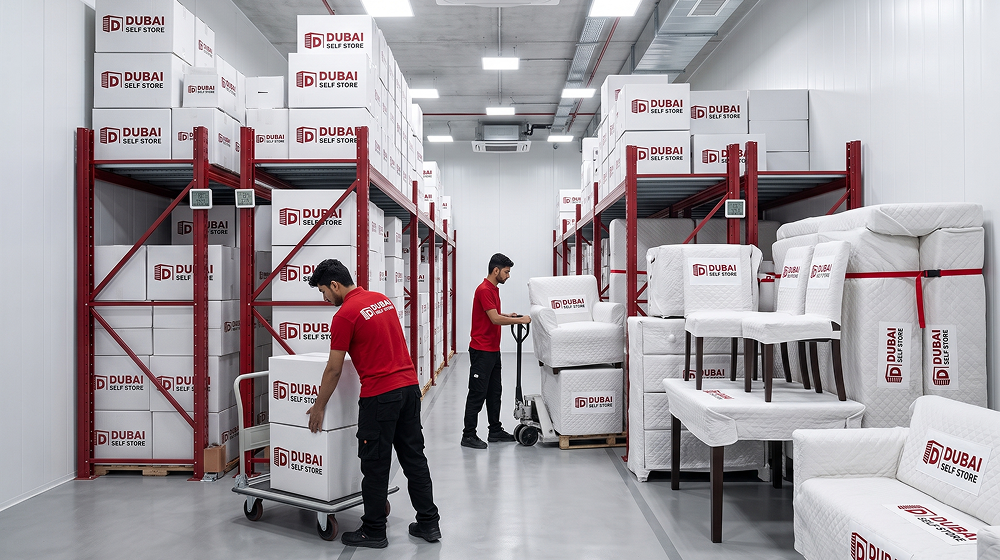
The room-count method is the quickest way to estimate storage space when you are planning a move, renovation, relocation or temporary storage. You start with the type of property and then adjust the expected size according to how heavily furnished it is.
It is useful because most people know their home type immediately. They may not know the cubic volume of their belongings, but they know whether they are moving out of a studio, 1-bedroom apartment, 2-bedroom apartment or villa.
Still, don’t treat these estimates as fixed rules. One person’s 1-bedroom apartment may contain a bed, sofa, wardrobe and ten boxes. Another person’s may contain two wardrobes, a large dining table, multiple appliances and fifty boxes. Same number of bedrooms. Completely different storage requirement.
Studio Apartment
A studio apartment will usually start in the 25–50 sq ft range. A lightly furnished studio with mostly boxes, clothes, luggage and smaller belongings may work well with 25 sq ft. If you are storing the bed, sofa, wardrobe, TV unit, appliances and a larger number of boxes, 50 sq ft is likely to be a more comfortable starting point.
For example, imagine someone leaving Dubai for six months and placing most of their studio belongings into storage. They have one bed, a small sofa, wardrobe, television, several kitchen items and ten boxes. A 25 sq ft unit might be possible if everything is packed carefully and larger furniture is dismantled, but 50 sq ft gives more room to organize those items without turning the unit into a tightly packed puzzle.
This is especially important if the renter expects to retrieve something later. A unit that fits everything tightly may work for long-term storage, but it becomes frustrating when you need to find one suitcase at the back.
1-Bedroom Apartment
For a 1-bedroom apartment, 50–100 sq ft is a useful starting range. A lightly furnished apartment may fit closer to 50 sq ft, while a normally furnished apartment containing the bedroom, living room, appliances and boxes is more likely to need around 100 sq ft.
Think about the major items first. A bed and mattress, wardrobe, sofa, dining table, chairs, TV unit, washing machine and refrigerator already take up a significant amount of space before you even count boxes.
That is why someone storing the full contents of a furnished 1-bedroom apartment should not automatically choose the smallest available unit simply because it is cheaper. The cheaper unit only saves money if everything actually fits and remains reasonably accessible. If the apartment is sparsely furnished, however, 100 sq ft could leave you paying for empty space. In that situation, 50 sq ft may be enough.
2-Bedroom Apartment
A 2-bedroom apartment generally starts around 100–150 sq ft, although the exact requirement depends heavily on furniture. A lightly furnished 2-bedroom apartment might fit within 100 sq ft if beds are dismantled, furniture is packed efficiently and there are not too many boxes. A fully furnished apartment with two beds, wardrobes, living room furniture, dining furniture, appliances and several dozen boxes may be more comfortable in 150 sq ft.
Furniture is usually what pushes the size upward. Boxes can be stacked. A sofa cannot suddenly become half its size because you need more room.
For example, someone renovating a 2-bedroom apartment may store almost everything temporarily. If the furniture includes a large sectional sofa, two beds, several wardrobes and a dining set, choosing 100 sq ft purely because it is the lower price could result in a difficult packing job. A 150 sq ft unit may give the furniture enough room to be positioned sensibly while still avoiding the cost of a much larger unit.
Villa
Villa storage is harder to estimate because the word “villa” tells you very little about the actual volume of belongings. A small, lightly furnished villa could require significantly less storage than a large family villa filled with furniture, appliances, children’s belongings, garden equipment and years of accumulated possessions.
For that reason, 150–300+ sq ft is a useful starting range for villa storage, but an inventory-based estimate is much more reliable. If you are storing the entire contents of a villa, make a list of your largest furniture pieces first. Count the beds, wardrobes, sofas, dining tables, cabinets and appliances. Then estimate the number of boxes and add unusual items such as bicycles, tools, outdoor furniture or sports equipment. A large villa can easily exceed the capacity of a 200 sq ft unit, particularly when the belongings are bulky and cannot be stacked efficiently.
Quick Home-Type Storage Guide
| Property or storage requirement | Suggested starting size | Typical situation |
|---|---|---|
| Personal belongings | 25 sq ft | Boxes, luggage, documents and seasonal items |
| Studio | 25–50 sq ft | Light to normal furniture and boxes |
| 1-bedroom | 50–100 sq ft | Apartment furniture and household contents |
| 2-bedroom | 100–150 sq ft | Larger household contents |
| 3-bedroom | 150–200 sq ft | Substantial household furniture |
| Villa | 150–300+ sq ft | Large or highly furnished homes |
| Business | 50–300+ sq ft | Stock, equipment and office contents |
These figures are starting points rather than guarantees. Actual requirements vary according to furniture size, packing method and access requirements.
How Do You Estimate Size by Volume? The Cubic Feet Method
If you want a more accurate estimate, move beyond bedrooms and calculate the approximate volume of your belongings. The basic formula is simple:
Length × Width × Height = Cubic feet
For reference, NIST measurement conversions can also be used when converting cubic feet to metric units.
For example, a box measuring 2 feet long, 1.5 feet wide and 1 foot high has a volume of 3 cubic feet. Ten boxes of that size would occupy approximately 30 cubic feet. This method becomes particularly useful when you have a lot of boxes. Suppose one renter has 30 small boxes and another has 30 large moving boxes. They both report “30 boxes,” but their actual storage requirements could be dramatically different.
If each small box occupies approximately 1.5 cubic feet, 30 boxes represent around 45 cubic feet. If the larger boxes occupy 4 cubic feet each, the same 30 boxes represent approximately 120 cubic feet. Same box count. Very different volume.
Furniture can be estimated in the same way. A sofa measuring roughly 7 feet long, 3 feet wide and 3 feet high has an approximate volume of 63 cubic feet. That doesn’t mean you need a 63-cubic-foot unit just for the sofa because real storage depends on orientation, available floor area and vertical space. It simply gives you a useful indication of how much room the item occupies. For a complete estimate, calculate or approximate the volume of your larger belongings, add your boxes and then allow some additional space for gaps and access.
Why Square Feet and Cubic Feet Are Both Useful
Square feet describe the floor area of a storage unit. Cubic feet describe the overall volume of the items you’re storing. That difference matters because storage is three-dimensional.
A unit with 100 sq ft of floor area can hold considerably more if the ceiling is high enough and your belongings can be stacked safely. Boxes, clothing containers and other stable items can often make better use of vertical space than large furniture.
However, you shouldn’t assume every available inch of height can be used. Heavy items may need to remain on the floor, fragile belongings need protection and some furniture cannot safely be stacked.
This is why square footage remains an important measurement when comparing actual storage units. Cubic feet help you understand your belongings; square feet help you compare the available units. The best estimate uses both.
How Do You Account for Boxes and Irregular Items?
Boxes are relatively easy to calculate because they are usually rectangular and stackable. Irregular items are much more difficult because they create gaps that cannot always be filled efficiently. A bicycle is a good example. Its total volume might not sound huge, but its wheels, handlebars and frame make it awkward to position alongside boxes and furniture.
The same applies to garden chairs, sports equipment, lamps, tools, exercise machines and children’s outdoor equipment. When using the calculator, separate your belongings into three groups: large furniture, stackable items and irregular items.
Start with the large furniture because those pieces usually determine the minimum floor area. Then add your boxes and smaller items. Finally, account for irregular objects that may require additional room.
For instance, a customer might have 25 boxes, one sofa, two wardrobes, one bed, a dining table and two bicycles. The boxes are easy to stack, but the sofa and bicycles cannot be treated like identical cartons. This is one reason why a 100 sq ft estimate may work for one person but not another person with the same number of boxes.
How Does Furniture Packing Change the Storage Size?
Packing technique can make a surprisingly large difference. A bed frame that remains assembled takes up more usable floor space than one that has been dismantled. The same applies to dining tables, shelving units and certain wardrobes.
If you’re comfortable dismantling furniture, label the screws and smaller parts and keep them together in clearly marked bags. This can reduce the amount of awkward empty space inside the unit. Mattresses can often be positioned vertically where appropriate, while uniform boxes can be stacked more efficiently than loose bags and miscellaneous containers.
However, don’t sacrifice safety simply to fit everything into a smaller unit. Heavy boxes should not be placed where they can fall, fragile items need suitable protection, and furniture should be wrapped where necessary. The objective isn’t to cram as much as physically possible into the smallest box. It’s to use the available space sensibly.
How Does Access Frequency Change the Size You Need?
How often you visit your storage unit should influence the size you choose. If you’re storing household belongings for six months and don’t expect to access them until moving into your next home, you can generally organize the unit more tightly. Items you won’t need can go toward the back, while boxes can be stacked to use vertical space. Frequent access is different.
If you’re likely to visit every week, you need enough room to find things without unloading half the unit. A little additional space may be worth paying for because it creates a practical access route. This is particularly important for business storage.
Imagine an online retailer storing 100 cartons of products. If the business needs to retrieve ten cartons every week, filling a 100 sq ft unit from wall to wall may make daily operations unnecessarily difficult. A slightly larger unit with organized shelving and access space could save considerable time.
The same principle applies to household storage. If you know you’ll need your winter clothes, children’s items or documents during the rental period, keep those belongings near the front and leave enough room to reach them.
Occasional access
If you rarely visit, prioritize efficient packing and use the available space carefully.
Monthly access
If you expect occasional retrievals, leave some practical access space and group similar items together.
Weekly access
If you’re regularly retrieving belongings, consider whether moving up one unit size will make the storage much easier to manage.
Which Storage Unit Size Is Most Commonly Rented in Dubai?
There isn’t one universal size that every Dubai storage provider rents most frequently because demand varies by location, customer type and inventory.
That said, 50 sq ft and 100 sq ft are useful mid-range options for many household storage requirements. Smaller customers can use 25 sq ft, while people storing larger apartments, villas or business inventory often move into 150, 200 or 300+ sq ft units.
The 100 sq ft category is particularly practical because it sits between compact personal storage and larger household or commercial requirements. It can work for many 1-bedroom apartment contents, renovation projects and moderate business inventory. But the most popular size isn’t necessarily the right size for you.
If you have eight boxes and two suitcases, 100 sq ft would be excessive. If you’re clearing a fully furnished villa, it could be far too small. Your belongings should determine the unit, not what happens to be the most commonly rented option.
What If Your Storage Estimate Falls Between Two Sizes?
This is where renters often get stuck. Suppose your belongings look like they could fit into 50 sq ft, but 100 sq ft would make everything much easier. The answer depends on how you intend to use the unit.
If you’re putting everything into storage for a few months and won’t need anything until the end of the rental period, efficient packing may make the smaller unit a better choice. If you expect regular access, the larger unit could be worth the additional cost.
You should also consider whether your furniture can be dismantled. If the sofa is compact and the dining table can be taken apart, your 50 sq ft requirement may become more realistic. If you have bulky furniture that cannot be dismantled, irregular items or a large number of boxes, the larger size may be safer.
When in doubt, give the storage provider an inventory of your largest items and your approximate box count. A provider can usually give you a more useful recommendation from that information than from the phrase “two-bedroom apartment” alone.
How Should Businesses Use the Storage Size Calculator?
Businesses looking for business storage in Dubai should calculate their space differently from households because inventory movement matters as much as inventory volume. A small online seller with a few cartons may need only 25–50 sq ft. A growing e-commerce business could need 100–200 sq ft, while a company storing equipment, event materials or substantial inventory may need 300+ sq ft. Don’t calculate only what you have today. Think about what arrives every month.
If your business currently has enough stock for 100 sq ft but you receive a new shipment every two weeks, the unit could become crowded quickly. In that situation, either allow some growth room or choose a storage arrangement that makes it easy to move to a larger unit.
Access should also be part of the calculation. A business that retrieves stock every day needs a very different layout from one that stores archived documents and rarely touches them. For business storage, consider the storage size alongside loading access, employee access, retrieval frequency and any pickup or delivery requirements.
What Is the Smallest Storage Unit You Might Need?
For renters with only a small amount of property, 25 sq ft can be enough. This size is useful for documents, luggage, seasonal clothing, several boxes and other personal belongings that don’t justify a larger unit. It can also be useful for someone who is moving abroad but wants to keep a small collection of belongings in Dubai. The mistake is assuming that a 25 sq ft unit can replace a full apartment storage space. It cannot.
If you need to store sofas, wardrobes, beds and appliances, start with a larger size and compare the dimensions rather than trying to squeeze everything into the smallest available option.
What Size Storage Unit Do I Need for Furniture?
When choosing furniture storage in Dubai, space requirements vary because different pieces have very different dimensions. A few pieces of compact furniture may fit comfortably into 50 sq ft, while a large sofa, multiple wardrobes and bedroom furniture can quickly push the requirement toward 100 sq ft or more.
If you’re storing furniture during a renovation, measure the larger pieces first. Write down the approximate length, width and height of each item and note which pieces can be dismantled. A dismantled dining table may occupy considerably less floor space than an assembled one. The same can be true of beds and shelving. Then add your boxes. This simple exercise can give you a much better idea of the storage requirement before you request a quote.
How Accurate Is a Dubai Storage Size Calculator?
A storage calculator can provide a useful initial estimate, but it cannot physically inspect your belongings or know the exact dimensions of every piece of furniture. Its job is to narrow down your options. If the calculator says you need 50–100 sq ft, you can compare those unit categories instead of looking at every possible storage size in Dubai.
The final recommendation should then be checked against your actual inventory. This is particularly important for villas, heavily furnished apartments, businesses and customers with unusual equipment. The calculator should therefore be treated as the first part of the process:
Home type → belongings → estimated volume → storage size → provider confirmation.
That gives you a much stronger starting point than choosing a unit based only on price.
A Simple Example: Choosing Between 50 and 100 Sq Ft
Consider a renter moving from a furnished studio. They have one bed, one wardrobe, a small sofa, a TV unit, a dining table, several kitchen items and around 15 boxes.
Based purely on the property type, the renter might start with 25–50 sq ft. But once the furniture is considered, 50 sq ft becomes the more realistic option. Now imagine another renter in the same size studio who has only eight boxes, two suitcases, clothing and documents because most of the furniture is being sold. That person may only need 25 sq ft. The apartment didn’t change. The storage requirement did. This is exactly why the calculator should ask about belongings rather than stopping after the user selects “studio.”
A Simple Example: Choosing Between 100 and 150 Sq Ft
Now consider a 2-bedroom apartment. The renter has two beds, two wardrobes, a sofa, dining table, six chairs, TV furniture, appliances and 35 boxes. A 100 sq ft unit might be possible with careful packing and dismantled furniture, but it could be difficult to access. A 150 sq ft unit provides more room to organize the larger furniture and leave practical access space.
If the renter will not visit the unit during the rental period, 100 sq ft may still be worth considering. If they expect to retrieve belongings every few weeks, the additional space could make the larger unit the better choice. Storage isn’t just about fitting everything inside. It’s about being able to use the space.
What Should You Do Before Booking a Storage Unit?
Before booking, make a quick inventory of the belongings you want to store. Start with your largest furniture pieces, then count the boxes and identify anything unusually shaped, fragile or difficult to stack.
Next, think about access. If you won’t need anything until the end of the rental period, you can prioritize compact packing. If you visit regularly, make sure the recommended unit gives you enough room to reach your belongings without constantly unpacking the entire space. Finally, compare the service specifications and prices, including the actual unit dimensions and total rental cost, rather than relying only on advertised square footage.
A 100 sq ft unit isn’t necessarily identical to another 100 sq ft unit. The layout, door position, ceiling height, access arrangements and storage conditions can all affect how useful the space feels.
Get Your Dubai Storage Size Estimate Before You Book
Choosing a storage unit becomes much easier when you stop thinking only in terms of bedrooms and start looking at the belongings themselves. A 25 sq ft unit can work for small personal storage, 25–50 sq ft is a useful starting point for studios, 50–100 sq ft for 1-bedroom apartments, 100–150 sq ft for 2-bedroom homes, and 150–300+ sq ft for larger homes and villas. Businesses should size their unit according to inventory volume and how often stock needs to move in and out.
The calculator gives you the starting point. Your actual inventory gives you the final answer. If your result falls between two sizes, compare the cost of both options and consider how frequently you will need access. Sometimes the smaller unit is the smarter choice. Sometimes paying for a little more room prevents months of frustration.
For a current recommendation, share your home type, furniture list and approximate number of boxes with Dubai Self Store. The provider can confirm which unit sizes are currently available and give you a quote based on your actual storage requirements. Use the calculator first, then request a current quote before booking.