Cheap Self Storage in Dubai: 6 Ways to Pay Less Without Risk
The easiest way to get cheap self storage in Dubai is to reduce the parts of your bill you do not actually need. Choosing a less central location, renting the right unit size, committing for longer when the rate makes sense, sharing space where appropriate, checking genuine online promotions, and skipping unnecessary services can all reduce your storage costs without forcing you to compromise on basic security.
Cheap storage does not have to mean choosing a facility simply because it has the lowest number on the page. In fact, chasing the cheapest possible monthly rent can backfire if the unit is too small, the location is inconvenient, VAT is added later, or essential services cost extra.
The smarter approach is to look at the whole rental cost. What size unit do you need? How long will you keep it? How often will you visit? Do you need pickup and delivery? Once you answer those questions, it becomes much easier to see where you can save and where cutting costs would simply create another problem.
For someone storing furniture during a home move, the priorities will be different from those of a small business storing inventory. A family may need a unit for six months, while a business might need the same space for several years. There is no single cheapest storage option for everyone. The goal is better value, not just a lower advertised price.
How Do You Get Cheap Self Storage in Dubai?
You can reduce the cost of self storage in Dubai by making a few practical decisions before signing a rental agreement. Start by comparing facilities outside the most expensive central districts, then look at whether a longer rental term gives you a better monthly rate. After that, make sure you are renting the smallest unit that comfortably fits your belongings rather than paying for empty space.
Sharing a unit can also work for certain customers, provided the storage provider permits it and responsibilities are clearly agreed. Online promotions may offer another saving, but check the terms carefully because some discounts only apply to the first month. Finally, look at optional services such as collection, delivery and retrieval. If you can handle some of those tasks yourself, you may be able to reduce the total cost further.
The important thing is to compare the final amount you will actually pay, not just the headline rental price.
A unit advertised at AED 500 per month may not remain the cheaper choice once VAT, transportation or other charges are added. Likewise, an AED 650 unit may provide twice as much usable space, making it better value if you genuinely need the extra capacity.
6 Ways to Pay Less for Storage Without Losing Security
1. Choose an Off-Centre District
Self Storage Facilities in Dubai can make a noticeable difference to storage prices in Dubai. Facilities in or close to highly sought-after residential and commercial districts can carry a higher rental cost because customers are also paying for convenience. If you do not need to visit your storage unit several times a week, looking slightly farther from the centre can be one of the simplest ways to lower your monthly bill.
For example, imagine you are comparing two 100 sq ft storage units. A facility in a more central area charges AED 800 per month, while a comparable unit in a less central location costs AED 600. The difference is AED 200 every month. Over six months, that becomes AED 1,200, and over a full year, you would save AED 2,400.
That is a meaningful reduction for someone storing items that rarely need to be accessed. Furniture, seasonal clothing, archived documents, spare equipment and long-term business stock can often sit safely for months without requiring frequent visits.
However, there is a limit to how far you should go for a cheaper unit. If you live nearby and expect to visit every weekend, a facility that takes a long drive each way may not actually save you much. Fuel, parking and your time all have a cost.
The better question is not simply, “Which district is cheapest?” It is, “How much convenience am I willing to give up for saving?”
For customers who rarely need physical access, a less central facility can make excellent financial sense. If you need frequent retrievals, location becomes much more important.
Example saving: AED 200 per month, or AED 2,400 over 12 months.
2. Commit to a Longer Contract
If you already know that you will need storage for a longer period, ask whether the provider offers a better rate for a longer commitment. Storage companies may prefer longer rentals because they provide more predictable occupancy, and some may pass part of that benefit on to customers through discounted monthly pricing.
Suppose the standard rate for your unit is AED 700 per month. Renting for 12 months at that rate would cost AED 8,400. Now imagine that a longer-term offer brings the price down to AED 600 per month. Your annual cost would fall to AED 7,200, giving you a total saving of AED 1,200.
That works out to AED 100 saved every month. The savings does not have to be huge to be worthwhile. Even AED 50 less per month means AED 600 saved over a year. For a household that plans to store furniture during a long renovation or a business that expects to hold inventory throughout the year, those smaller reductions can add up.
There is one important catch. Do not sign a long contract simply because the monthly rate looks attractive if you are not confident you will need the space. Check the cancellation and notice terms first. A discount is not useful if ending the agreement early creates additional costs or leaves you paying for months you no longer need.
Longer-term pricing works best when your storage requirement is predictable. If you are certain you will need the unit for a year or more, it is worth asking for the best available long-term rate before booking.
Example saving: AED 100 per month, or AED 1,200 over 12 months.
3. Right-Size the Unit
One of the most effective ways to reduce storage costs is also one of the easiest to overlook: rent only as much space as you actually need. Carefully look at the self-storage unit sizes in Dubai.
People often choose a larger unit because they are worried that their belongings will not fit. That is understandable, particularly when you’re standing in front of a pile of furniture and boxes wondering how it could possibly fit into a smaller space.
But extra square footage costs money every month. Imagine a 50 sq ft unit costs AED 400 per month while a 100 sq ft unit costs AED 650. Choosing the larger unit means spending an additional AED 250 every month. Over a year, that is AED 3,000.
If your belongings comfortably fit into 50 sq ft, that extra AED 3,000 is effectively paying for unused space. On the other hand, going too small can create its own problems. If you cram a sofa, boxes and appliances into a unit that is clearly undersized, you may block access to your belongings. The box you need next month could end up buried behind everything else.
A good rule is to choose the smallest unit that can comfortably accommodate your belongings while leaving enough room to organize and retrieve items.
Before renting, sort through what you actually intend to keep. Broken furniture, unwanted clothes and items you have not used in years may not deserve another year of monthly storage fees. If removing a few things allows you to move from a 100 sq ft unit to a 50 sq ft unit, the financial difference can be significant.
Using the example above, moving from AED 650 to AED 400 saves AED 250 per month. Over 12 months, that is AED 3,000. That is a much better saving than trying to negotiate a few dirhams off the monthly rate.
Example saving: AED 250 per month, or AED 3,000 over 12 months.
4. Share a Unit
Sharing storage can be an effective way to reduce the cost when two people have relatively small storage requirements. It may work for friends, family members, business partners or small businesses that do not need a full unit each.
Suppose a 100 sq ft unit costs AED 700 per month. If two people split the space equally, the basic rental cost becomes AED 350 per person. If each person would otherwise rent a separate 50 sq ft unit at AED 450, sharing would reduce the individual cost by AED 100 per month. Over a year, each person could save AED 1,200.
There is a practical side to this arrangement, though. Do not simply hand your access details to another person and assume everything will be fine. Confirm that the storage provider allows shared access and find out how additional users need to be registered.
It is also worth agreeing in advance about who pays what, how the space will be divided and what happens if one person wants to leave. For business partners, this becomes even more important because stored inventory may have significant value.
A cheap shared unit can become very inconvenient if one person stops paying or both users need access at the same time. Sharing makes the most sense when both parties have modest storage requirements and the arrangement is clearly documented. If you are comfortable with the setup and the provider permits it, splitting a larger unit can reduce the cost per person considerably.
Example saving: around AED 100 per person per month, or AED 1,200 per person annually.
5. Book Online for Discounts
Online promotions can sometimes reduce your initial storage cost, particularly when a provider is running a new-customer offer or a booking promotion. These offers are worth checking, but there is an important rule: look at the final price rather than the size of the discount printed in the advertisement.
For example, imagine a storage unit normally costs AED 800 per month and a provider offers 20% off. The discount is AED 160, bringing the promotional price down to AED 640. If that discount applies for six months, the saving is:
AED 160 × 6 = AED 960.
That is a useful reduction. But suppose the 20% discount applies only to the first month. Your first month would cost AED 640, while the following five months would cost AED 800 each. Your six-month total would then be AED 4,640 instead of AED 4,800. Your actual savings would be only AED 160.
There is nothing wrong with that promotion. The problem comes when customers assume the discounted rate continues for the whole rental period when it does not. Before booking an online offer, check how long the promotion lasts, whether VAT is included, which unit sizes qualify and what price applies once the promotional period ends. Also check whether a minimum rental period is attached to the offer.
A genuine online discount can be useful. Just make sure you know what you are agreeing to before treating the promotional price as your long-term storage budget.
Potential saving: AED 50–200+ per month during a genuine promotional period, depending on the offer.
6. Skip Services You Don’t Need
Pickup, delivery, packing and retrieval services can make storage much easier, especially when you are moving furniture or managing business inventory. But convenience has a price, so if you do not need a particular service, there is no reason to automatically add it to your storage budget.
Imagine a provider charges AED 150 for a pickup. If you use that service four times during a year, you have spent AED 600 on transportation. If you already have a suitable vehicle and can move the belongings yourself, that may be an avoidable cost. The opposite can also be true.
If you do not have a vehicle capable of moving furniture, hiring a van and paying someone to help could cost as much or more than the storage company’s pickup service. In that situation, the paid service may actually be the better financial decision.
This is why “skip every extra service” is not the right rule. The better rule is to pay only for services that provide real value to you.
Before adding a service, think about how often you will use it and what it would cost to arrange independently. A business that needs regular inventory movement may benefit from a storage provider’s delivery service, while someone storing winter clothes may never need a retrieval service at all.
Potential saving: AED 100–500+ per year, depending on the services you would otherwise use.
How Much Can Each Method Save You?
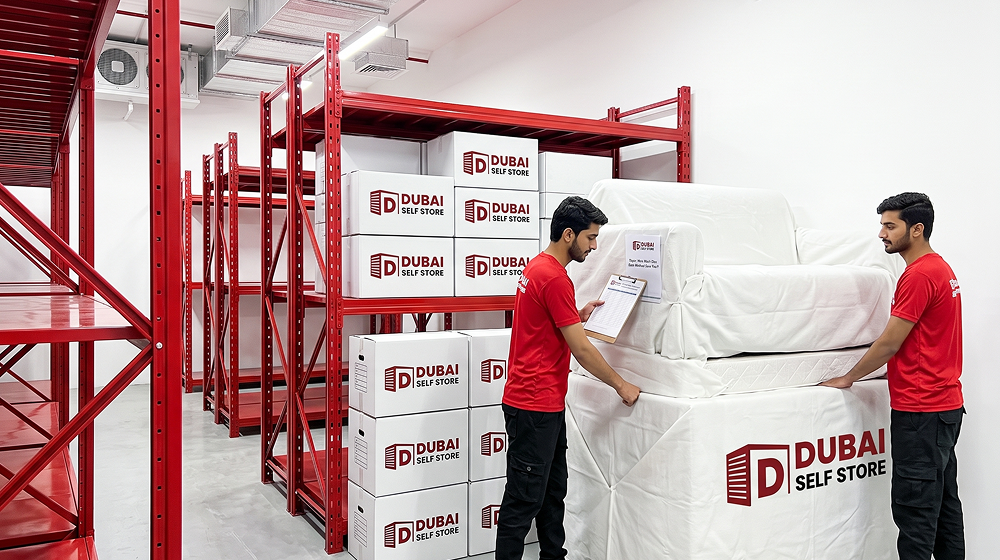
The exact savings will depend on the storage provider, unit size, location, rental period and services involved. The following examples show how the six methods could affect an annual storage budget when applied to realistic scenarios.
| Saving method | Example monthly saving | Example annual saving |
|---|---|---|
| Choosing a less central location | AED 200 | AED 2,400 |
| Longer rental commitment | AED 100 | AED 1,200 |
| Choosing a smaller suitable unit | AED 250 | AED 3,000 |
| Sharing a unit | AED 100 per person | AED 1,200 per person |
| Online promotion | AED 160 during offer | Depends on duration |
| Avoiding unnecessary services | Varies | AED 100–500+ |
These figures are examples rather than guaranteed discounts. A customer may save nothing from one method while saving considerably through another. The point is to identify which part of your own storage bill has room to move.
For example, a customer renting a 100 sq ft unit for AED 800 might reduce the cost to AED 650 by choosing a different suitable unit. If a long-term rate then brings that down to AED 600, the customer has already saved AED 200 every month compared with the original quote.
Over a year, that becomes AED 2,400. If they also avoid unnecessary delivery charges, the total savings can be higher. This is why storage costs are better viewed as a collection of decisions rather than one fixed price.
What Cheap Storage Options Should You Avoid?
There is nothing wrong with looking for affordable storage but don’t overlook secure self-storage in Dubai. The problem begins when a low price comes with unclear terms, poor conditions or missing information about what you are actually paying for.
Start with security. A storage facility should give you confidence that your belongings are being kept in an appropriately controlled environment. If a provider is vague about access procedures or basic facility security, saving AED 50 a month may not be worth the uncertainty.
Then look at the rental agreement. You should understand the monthly price, payment schedule, notice requirements, access rules and what happens if payments are missed. A professional provider should be able to explain these terms clearly before you sign.Customers can also review the UAE Government’s consumer protection guidance to understand their general rights when dealing with service providers.
Hidden costs deserve attention too. Ask whether the advertised price includes VAT and whether deposits, administration charges, transportation, retrieval or other services are billed separately. An AED 400 headline price can quickly become a much larger monthly expense if several extras are added.
You should also consider whether the facility is suitable for the items you plan to store. Documents, furniture, electronics and business inventory may have different storage requirements. The cheapest unit is of little use if its conditions are unsuitable for your belongings. In short, cheap should mean efficient, not careless.
Is the Cheapest Unit Always the Best Value?
No. The cheapest monthly unit and the best-value unit are not necessarily the same thing. Imagine two options. Unit A is 25 sq ft at AED 200 per month. Unit B is 50 sq ft at AED 300. On a simple monthly-price comparison, Unit A wins immediately because you spend AED 100 less. But now calculate the price per square foot.
Unit A costs AED 8 per sq ft.
Unit B costs AED 6 per sq ft.
Unit B provides twice the space for only AED 100 more each month.
If you genuinely need 45 or 50 sq ft, Unit B may be the better value. If you only need 20–25 sq ft, paying extra for unused capacity does not make sense. That is why the right approach is to right-size first and compare prices second.
The same principle applies to location and services. A unit that costs slightly more but saves you repeated transport expenses may work out cheaper overall. A facility with a slightly higher rental price but fewer additional charges may also be the better deal. Storage is not a competition to find the smallest number. It is about finding the right balance between space, price, location, security and convenience.
How to Find Affordable Storage Without Cutting the Wrong Corners
If your goal is to keep your storage bill as low as reasonably possible, start by making a realistic list of everything you plan to store. Remove items you no longer need, group the remaining belongings and estimate the amount of space required. This gives you a much better starting point than choosing a unit based only on price.
Next, think about how often you will need access. If the unit is for seasonal items or long-term storage, you may be comfortable choosing a facility farther from the centre. If you are running a business and need to retrieve stock regularly, convenience may justify paying a little more.
Then ask about rental terms. If you know you need storage for a year, find out whether a longer commitment gives you a lower monthly rate. If your rental period is uncertain, don’t commit simply for the sake of a discount.
When comparing quotes, make sure you are comparing the same things. Check the unit size, monthly rent, VAT, access arrangements and any additional charges. A quote is only useful when you understand the total cost.
Finally, consider whether you actually need every additional service. Pickup and delivery can be extremely useful, but they are not essential for every customer. If you can handle a task yourself without creating significant cost or inconvenience, that is another place where your storage budget may shrink.
Cheap Storage Should Mean Better Value, Not Fewer Protections
The safest way to reduce your storage costs is not to sacrifice the things that protect your belongings. Instead, look for waste in the rental itself.
- Choose a unit that fits.
- Compare locations.
- Ask about longer-term rates.
- Check legitimate promotions.
- Share only when the arrangement is permitted and clear.
- Avoid paying for services you will never use.
For customers comparing options in Dubai, Dubai Self Store publishes storage pricing starting from AED 150/month, giving customers a useful starting point when planning their storage budget. Exact prices can vary according to unit size, availability and storage requirements, so it is sensible to request the current rate before booking.
The goal is not to find the cheapest storage unit in Dubai at any cost. The goal is to find secure, suitable storage at a price that makes sense for your actual needs. A few minutes spent comparing the numbers can save hundreds of dirhams over the course of a rental. And that is the kind of discount worth having.