How Dubai Heat, Humidity, and Dust Damage Stored Items
Dubai’s summer heat, humidity and dust can damage stored belongings in different ways: temperatures above 45°C can accelerate material breakdown and battery damage, high relative humidity can encourage mould and corrosion, while fine dust can work its way into electronics, fabrics and furniture. This is why the type of storage matters just as much as the storage period. A sofa, laptop, leather bag and box of documents do not react to Dubai’s climate in quite the same way.
A few weeks of storage may not cause noticeable problems. Leave the same belongings in an unsuitable environment for several months, though, and small changes can become expensive repairs or permanent damage.
The good news? You don’t need to panic every time Dubai’s temperature climbs. You need to understand which belongings are vulnerable and choose storage conditions accordingly.
How Does Dubai’s Climate Damage Stored Items?
Dubai’s climate creates three main challenges for stored belongings: high temperature, moisture and airborne dust. They can work separately, but they often overlap.
Heat speeds up chemical reactions and can cause some materials to soften, expand, dry out or degrade. Humidity introduces moisture into the surrounding air, which can contribute to mould growth, corrosion and swelling in moisture-sensitive materials. Dust is less dramatic, but over time it can settle into fabrics, vents, mechanical parts and electronic components. The risk also depends on how long something is stored.
A wooden table sitting in a hot environment for a weekend is not the same as a wooden table sitting there for six months. Likewise, a laptop sealed in a dusty box may look perfectly fine when you put it away, only for dust to accumulate around vents and components over a longer period.
Here’s the practical picture:
| Material | Main climate risk | Useful threshold or reference point | Better prevention |
|---|---|---|---|
| Wood | Expansion, contraction, warping | Keep RH preferably around 40–60% | Stable temperature and humidity |
| Furniture | Fabric damage, odour, mould | Avoid prolonged high humidity | Climate control and breathable covers |
| Electronics | Heat, battery degradation, corrosion | Avoid prolonged temperatures above ~35°C | Cool, dry storage |
| Leather | Drying, cracking, mould | Prefer RH around 40–60% | Stable humidity and conditioning |
| Fabric | Mould, odour and dust | Mould risk rises with sustained high RH | Dry, clean, covered storage |
| Paper | Warping, mould and yellowing | Prefer moderate RH around 30–50% | Dry, stable environment |
| Metal | Corrosion | High RH increases corrosion risk | Low, stable humidity |
| Plastics | Softening or deformation | High heat can accelerate ageing | Moderate temperatures |
These aren’t magic cut-off points where damage suddenly begins. Material behaviour depends on exposure time, construction, coatings, previous condition and the specific environment. Think of the numbers as practical storage targets rather than guarantees.
How Does Heat Above 45°C Damage Belongings?
Dubai’s summer temperatures can become extremely high. Official Dubai climate information from the Government of Dubai reports average summer highs around 41.8°C and describes Dubai’s climate as hot and humid. The important detail is that the temperature inside an enclosed, poorly ventilated space can behave differently from the official outdoor air temperature. A metal container or uninsulated room exposed to the sun can become substantially hotter than the surrounding air. Heat affects belongings in several ways.
Wood and other materials expand when heated and contract as they cool. Repeated cycles can contribute to movement, joints loosening or surfaces changing shape. Adhesives can also soften under excessive heat. This matters for furniture, laminated surfaces, shoes, bags and products assembled using glues.
Electronics have their own problems. Batteries generally age faster when exposed to high temperatures, while prolonged heat can shorten the useful life of electronic components and accelerate degradation of plastics and seals. A practical target for sensitive household belongings is to keep the storage environment well below the extreme temperatures that can occur outdoors during Dubai summer. For many ordinary household items, a controlled environment around 18°C to 24°C provides a much more stable condition than an unconditioned storage space. That doesn’t mean every item requires exactly 18°C to 24°C. It means stable, moderate conditions are preferable to repeated exposure to extreme heat.
How Does Humidity Cause Mould and Warping?
Humidity is often the less obvious problem. You can’t see relative humidity the way you see dust. But moisture in the air can have a significant effect on materials, particularly when belongings are stored for a long period.
Relative humidity above about 60% is generally considered a level where mould risk becomes more concerning, particularly when surfaces remain damp or poorly ventilated. At higher humidity, materials such as wood, paper and textiles can absorb moisture. Wood is hygroscopic, which means it naturally exchanges moisture with the surrounding air. If humidity changes significantly, the wood can expand or contract.
That can lead to:
- Warping
- Cracking
- Swelling
- Loose joints
- Changes in doors and drawers
- Surface damage
Paper has a similar problem. Documents can absorb moisture, causing pages to curl, stick together or develop mould under sufficiently damp conditions. Leather is another sensitive material. Too much moisture can encourage mould, while very dry conditions can contribute to drying and cracking. This is why climate-controlled storage isn’t simply about making a unit feel comfortable for humans. Stable humidity protects materials.
How Does Dust Affect Stored Items?
Dubai’s dust is a practical storage problem, especially when belongings are kept in spaces that are not properly sealed or maintained. Fine dust can settle on furniture, clothing and shelves. It can also enter electronic equipment through ventilation openings. A little dust isn’t going to destroy your belongings overnight. The problem is accumulation.
Imagine putting a desktop computer into a storage unit for eight months. If the unit is dusty, fine particles can gradually collect around vents and internal components. When you eventually take the machine home and turn it on, that accumulated dust is still there. Dust can also become difficult to remove from fabric, upholstery and textured surfaces.
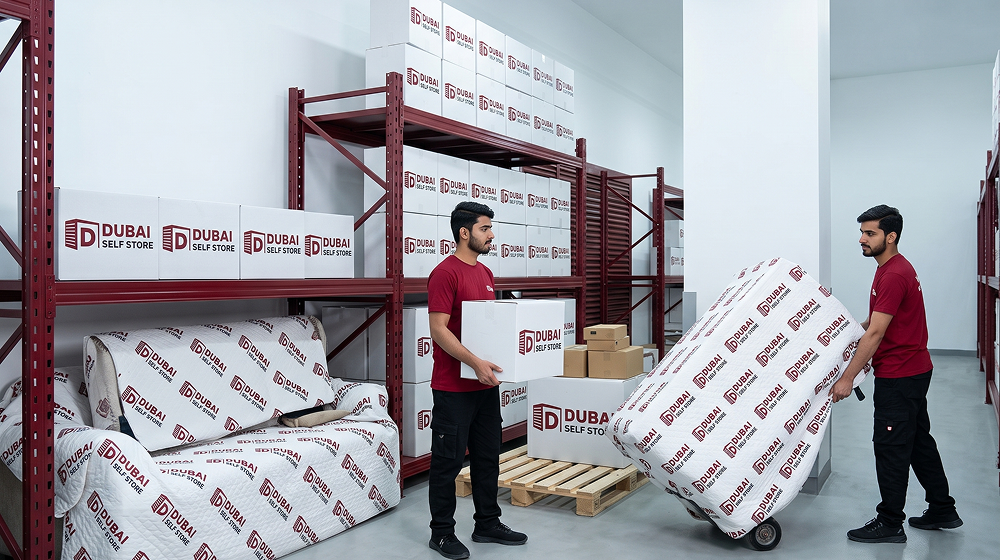
For furniture, use suitable protective covers that allow appropriate airflow rather than wrapping everything tightly in non-breathable plastic for long periods. For smaller belongings, sealed storage boxes can help reduce dust exposure. Clean items before storing them, too. It sounds obvious, but putting dusty furniture into storage simply gives you dusty furniture later.
Which Materials Are Most at Risk?
Different belongings respond differently to Dubai’s climate. Some are fairly forgiving. Others are not.
Wood and Furniture
Wood is one of the materials most affected by changes in temperature and humidity. A wooden dining table, wardrobe or antique cabinet can respond to changes in moisture by expanding and contracting. Over time, this movement can contribute to warping, cracks or changes in the fit of doors and drawers.
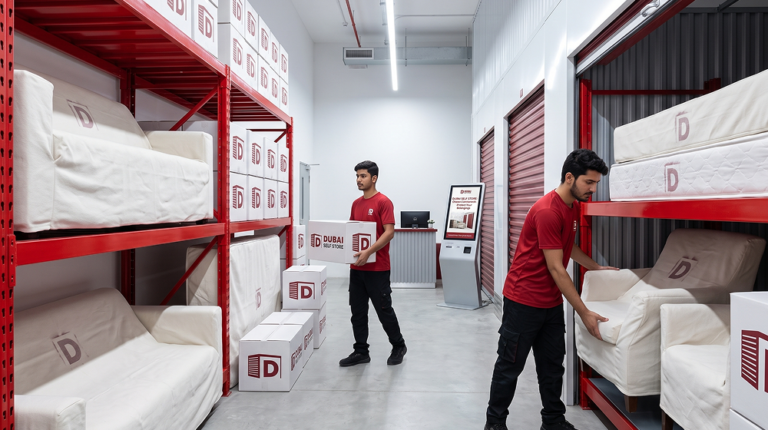
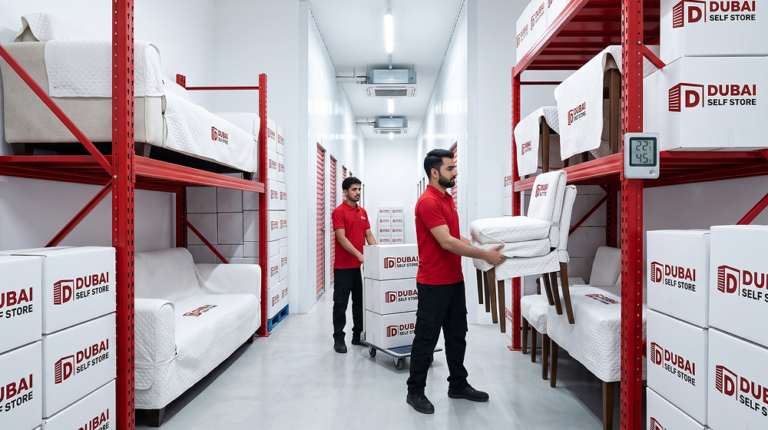
Furniture finishes can also suffer from prolonged heat. Before using furniture storage in Dubai, clean wooden furniture properly, make sure it is completely dry and protect it with suitable breathable covers. Avoid placing it directly on a damp floor. Use suitable furniture covers and leave enough space around larger pieces for air circulation. For expensive or antique furniture, controlled temperature and humidity are particularly worthwhile.
Electronics
Electronics don’t like extreme heat, moisture or dust. Laptops, televisions, gaming consoles, cameras and other devices contain components that can be affected by prolonged high temperatures. Batteries are particularly sensitive to heat and can lose capacity more quickly when stored in unsuitable conditions.
Humidity creates another problem. Moisture can contribute to corrosion of metal contacts and electronic components. Dust can settle around vents and cooling systems. Before storing electronics, clean them, disconnect batteries where the manufacturer permits it, use suitable packaging and keep them away from direct heat. For expensive equipment, climate-controlled storage is a sensible choice.
Leather and Fabric
Leather can be surprisingly fussy. Excessive dryness can contribute to stiffness and cracking, while excessive humidity can encourage mould. Fabric furniture and clothing can also develop musty smells or mould when moisture remains trapped in the material. Never put damp clothes, cushions or upholstery into storage. They need to be completely dry first.
For leather furniture or bags, clean and condition the material according to the manufacturer’s recommendations before storage. Use breathable protective covers rather than sealing leather tightly in plastic for months.
Paper and Documents
Important documents are among the belongings that deserve the most careful storage. Paper can absorb moisture from humid air. Prolonged exposure can cause pages to curl, stick together or develop mould. Heat and light can also accelerate ageing and discolouration.
For passports, certificates, contracts, photographs and other irreplaceable documents, use protective folders or archival-quality storage materials where appropriate. Keep documents elevated from the floor and away from potential water sources. If something cannot be replaced, don’t rely on a cardboard box sitting in an uncontrolled storage room.
Climate-Controlled Storage: How Does It Prevent Damage?
Climate controlled storage in Dubai works by maintaining a more stable environment rather than allowing stored belongings to experience the extreme temperature and humidity conditions of an uncontrolled space. A suitable facility can control temperature and, depending on the system, humidity. This helps reduce the repeated environmental swings that can affect sensitive belongings.
For many household items, a temperature range around 18°C to 24°C is a useful controlled-storage target. Relative humidity is ideally kept in a moderate range, commonly around 40–60%, depending on the materials being stored. The goal isn’t to create laboratory conditions. It’s stability.
Think about a wooden cabinet. If the surrounding environment repeatedly swings between very hot and humid and then cooler and drier, the cabinet is continually responding to those changes. A stable environment reduces that stress. Climate control also makes sense for belongings such as:
- Electronics
- Wooden furniture
- Leather goods
- Important documents
- Artwork
- Musical instruments
- Photographs
- Upholstered furniture
- Sensitive business inventory
Not everything needs climate control. Plastic storage bins, garden equipment and some robust household items may tolerate ordinary conditions much better. The right choice depends on what you’re storing.
Material-by-Material Damage Guide
If you’re deciding whether climate-controlled storage is worth paying for, this is the quick comparison to keep in mind:
| Material | What heat does | What humidity does | What dust does | Recommended approach |
|---|---|---|---|---|
| Wood | Expansion and contraction | Swelling, warping and mould risk | Settles on surfaces | Stable temperature and RH |
| Upholstered furniture | Can dry materials and adhesives | Mould and odour | Embeds into fabric | Covers + climate control |
| Electronics | Accelerates component and battery ageing | Corrosion risk | Blocks vents and settles internally | Cool, dry storage |
| Leather | Can dry and crack | Mould and staining | Dirt accumulation | Moderate RH + breathable cover |
| Clothing | Can weaken some fibres over time | Mould and musty odour | Staining and contamination | Clean, dry, sealed appropriately |
| Paper | Accelerates ageing | Warping and mould | Surface contamination | Dry, stable environment |
| Metal | Can affect finishes | Corrosion | Surface contamination | Dry storage |
| Plastics | Can soften or deform under high heat | Usually lower risk | Surface contamination | Avoid extreme heat |
How Long Is Too Long in Uncontrolled Storage?
There’s no universal number of days after which belongings suddenly become damaged. Exposure risk depends on the material, temperature, humidity, packaging and storage duration. A few weeks in a dry environment may cause little visible change. Several months through a Dubai summer can be a very different story, particularly for sensitive materials.
That’s why the question shouldn’t simply be, “How long will I store this?” Ask, “What am I storing, and what environment will it experience during that period?” Someone storing plastic garden chairs for three months has a very different requirement from someone storing a leather sofa, television, photographs and wooden furniture for a year.
How to Prepare Belongings Before Storage
Climate control isn’t a substitute for good preparation. Clean furniture before storing it. Make sure clothes and upholstery are completely dry. Empty appliances. Remove food. Back up important digital files. Photograph valuable belongings before packing them. Use sturdy boxes and don’t overload them.
For wooden furniture, protect vulnerable surfaces while allowing appropriate ventilation. For clothing, use clean storage containers or breathable garment protection suitable for the material. Electronics should be stored clean and dry, preferably in their original packaging when available. And don’t push every box tightly against every wall. A little breathing room makes inspection and retrieval much easier.
Choosing the Right Storage Environment in Dubai
Dubai’s climate doesn’t mean every item needs a temperature-controlled unit. It does mean that renters should make the decision based on the belongings rather than simply choosing the cheapest available space. If you’re storing durable items for a short period, standard storage may be perfectly adequate. If you’re storing wooden furniture, leather, electronics, important paperwork, artwork or valuable household belongings for several months, climate-controlled storage becomes much more attractive. The basic principle is simple: heat, humidity and dust don’t damage every material equally, but they can all become problems when exposure continues for long enough.
Before booking a unit, ask the facility what temperature range it maintains, whether humidity is controlled, how the space is protected from dust and what preparation they recommend for sensitive belongings. Your furniture, electronics and documents have already survived enough Dubai summers. They don’t need to spend the next one sitting in an uncontrolled environment.